
|
Compression driver selection |
Post Reply 
|
| Author | |
Jack1991 
Young Croc 
Joined: 05 February 2020 Location: Bristol Status: Offline Points: 519 |
 Post Options Post Options
 Thanks(0) Thanks(0)
 Quote Reply Quote Reply
 Topic: Compression driver selection Topic: Compression driver selectionPosted: 13 April 2025 at 3:54pm |
|
Currently have P-Audio BM-D26 compression drivers mounted to B&C ME10 horns. Manufacture specs for the CD's show this response: 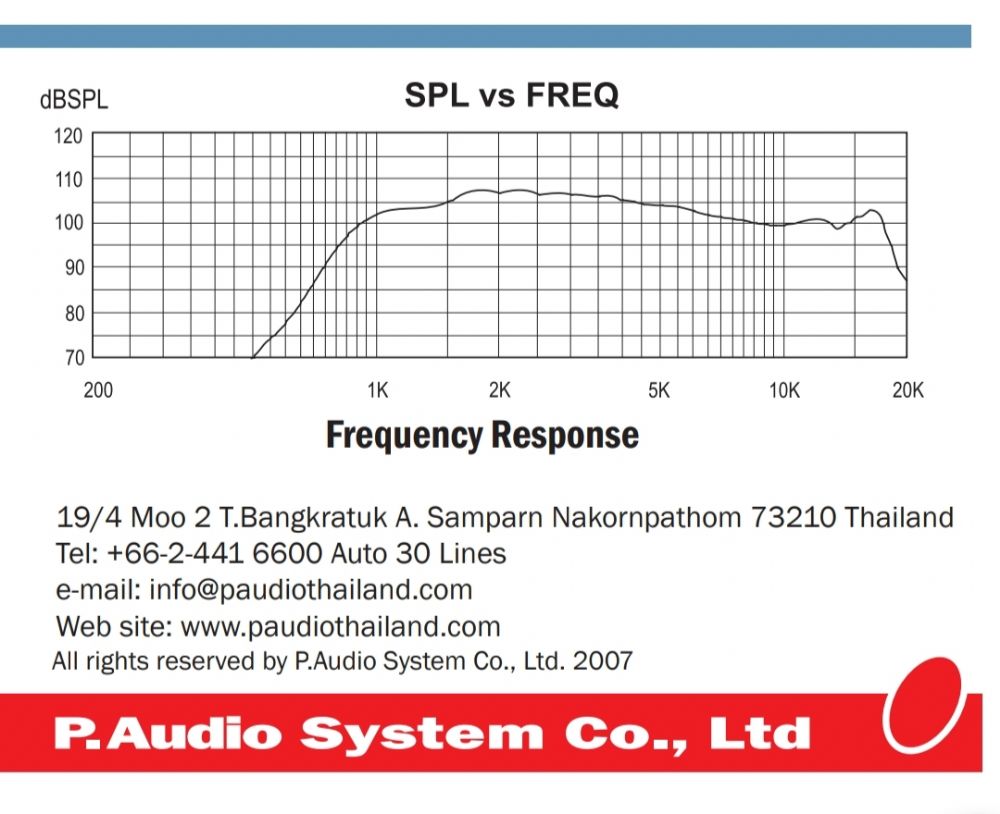 But from my REW measurements I think it looks miles off. 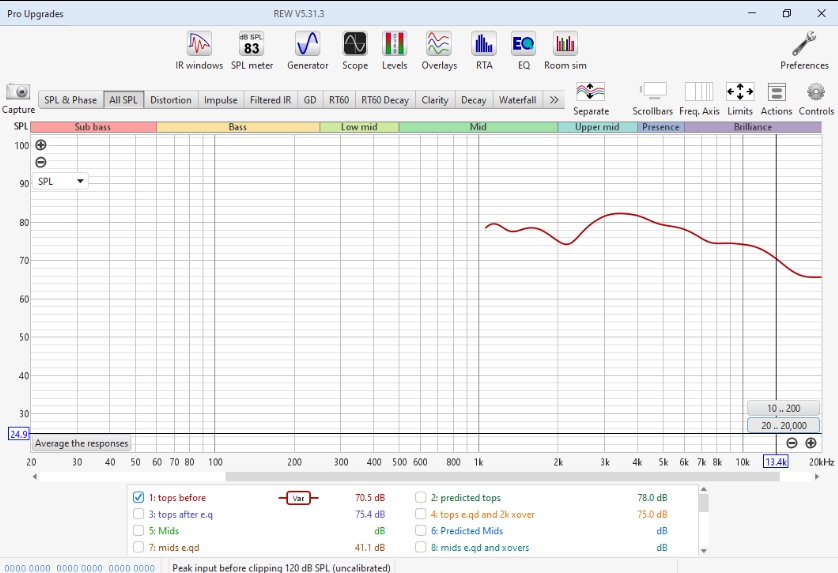 I know they're only cheap drivers so wasn't expecting much, but now I'm getting more into it I can notice they don't have that nice top end shine. I dont need loads of power as it's only for a 12v system, but I'd like to upgrade them to some with a better response and some nice top end. However, I'm unsure how to select them as I don't know if I can trust the specs on others. Or if I'm reading or doing something wrong anyway? Any help/advice greatly appreciated
Edited by Jack1991 - 13 April 2025 at 4:10pm |
|
 |
|
|
fudge22
Registered User 
Joined: 26 July 2022 Location: UK Status: Offline Points: 263 |
Post Options
Thanks(0)
Quote Reply
Posted: 13 April 2025 at 6:34pm |
|
All drive units have a falling power response as the frequency increases, both cones and compression drivers. A usually narrowing dispersion pattern masks this and keeps the on axis spl level flatter to higher frequencies.
The B&C horn is likely to maintain the constant directivity spreading the available power over a wider area, leading to a perceived lack of hf. The usual method to circumvent this is to boost the higher frequencies. Search on the internet for constant directivity horn equalisation, and as you are able to measure the system, does it sound OK when equalised to a flat response? Buying a more expensive drive unit may not cure your problem. |
|
|
|
|
Jack1991
Young Croc
Joined: 05 February 2020 Location: Bristol Status: Offline Points: 519 |
Post Options
Thanks(0)
Quote Reply
Posted: 13 April 2025 at 6:45pm |
|
Ah ok cool thanks I will give that a Google.
I have been reluctant to boost the highs too much as i don't want to overdo it. I have instead been reducing the other frequencies to compensate, rather than boost the ones I want up. When equalised flat it sounds ok, but can tell it would sound better again with a rising response.
Edited by Jack1991 - 13 April 2025 at 6:47pm |
|
|
|
|
MarjanM
Old Croc 

Joined: 10 February 2005 Location: Macedonia Status: Offline Points: 7844 |
Post Options
Thanks(0)
Quote Reply
Posted: 13 April 2025 at 9:47pm |
|
Response will havily depend on the horn used. Read in the spec sheet which horn P-audio used to ge tthat plot and try to find the same horn.
Edited by MarjanM - 13 April 2025 at 9:47pm |
|
|
Marjan Milosevic
MM-Acoustics www.mm-acoustics.com https://www.facebook.com/pages/MM-Acoustics/608901282527713 |
|
|
|
|
Line Array
Registered User
Joined: 19 March 2022 Location: New Jersey, USA Status: Offline Points: 204 |
Post Options
Thanks(0)
Quote Reply
Posted: 13 April 2025 at 11:26pm |
|
basically what others said - the reason you measure less highs is because you use a real world horn whereas manufacturer measurements use a horn that has the flattest response on-axis ( at the expense of horrible off-axis response that they simply do not measure )
Faital is probably the worst offender with their Tractrix horns that they use to measure their drivers on. Those horns make it look like their drivers magically can go flat to 20 khz but it's only in like a 10 degree laser beam so maybe one person in the crowd will get that response and everybody else will not hear anything above 5 khz. EQ the highs. if the driver can't take that much power and either begins to distort or blows - then upgrade the driver to one that is more powerful. but don't expect any driver to go flat to 20 khz on a real world horn. and don't expect a tractrix horn to be useful in the real world, except in maybe a studio monitor that only is being listened to by a single person at a time. the response you measured frankly looks pretty good. it rolls off but that is to be expected regardless of driver price. the rolloff is impressively smooth for a budget driver. mainly the response looks good because it's a very small compression driver. any "upgrade" driver would have to be a larger driver and the response likely would look WORSE than this, but it would be able to take more EQ before blowing. also keep in mind if you blow this driver and want to upgrade you will likely need to upgrade the horn too because most big drivers want 1.4" horn throat not the 1" throat. i say EQ it until it sounds the way you want. if it blows from too much power then upgrade it to a driver with larger voice coil. your driver has 1" voice coil - that's basically the smallest. 4" is the largest. although Celestion makes one with 5" VC ( for $1,000 ) and BMS makes a coaxial with one 3.5" and another 1.75" ( for $800 ) and JBL makes D2 with two 3" voice coils but apparently there is no way to replace the diaphragms on that one. once you blow your 1" VC driver try upgrading to 1.75" - that will probably still work on a 1" horn. if that blows too upgrade to 2.5" or 3" voice coil on 1.4" horn. if that also blows then you need BMS coaxial. if you blow that then it's time for arrays.
Edited by Line Array - 15 April 2025 at 12:13am |
|
|
|
|
fudge22
Registered User
Joined: 26 July 2022 Location: UK Status: Offline Points: 263 |
Post Options
Thanks(0)
Quote Reply
Posted: 15 April 2025 at 10:21pm |
|
If you look closely at the response graphs, in the mid section, there is not that much difference between them. Using the level between 3 and 4KHz as a reference, the level is about 7dB down at 10KHz in P-Audio’s graph and 8dB down in yours. The frequency axis is more stretched in P-Audio’s making the roll off look less steep.
The high frequency peak (P-Audio) will most likely be due to some resonance, and the dip in response (Your’s) above 2KHz is probably due to the ME10 horn, which is quite small. If you are using dsp to eq the response, it makes no difference if you boost the highs, or cut the lows to flatten the response. Once it is flat, you will need to adjust the overall level to match the driver in the frequency band below the horn. |
|
|
|
|
Post Reply
|
|
| Tweet |
| Forum Jump | Forum Permissions You cannot post new topics in this forum You cannot reply to topics in this forum You cannot delete your posts in this forum You cannot edit your posts in this forum You cannot create polls in this forum You cannot vote in polls in this forum |


 Topic Options