
|
Horn for X15 |
Post Reply 
|
Page 12> |
| Author | |
Phil.2008 
Registered User 
Joined: 10 July 2008 Location: Stamford, UK Status: Offline Points: 331 |
 Post Options Post Options
 Thanks(0) Thanks(0)
 Quote Reply Quote Reply
 Topic: Horn for X15 Topic: Horn for X15Posted: 02 February 2009 at 5:54pm |
|
I've decided on the BM-D740 (or maybe 50) for my X15s but I've just realised I'm restricted somewhat as to which horns I can fit on to it. I don't really want to start modifying the design so it leaves me with a maximum area of 240mm x 480mm. This rules out the 18sound horns I've been considering and the B&C ME90.
I don't want to use the PH-3223 because of the rapid changes in flare angle it has (along with quite a few other P.Audio horns) and the apparent "horn honk" this can cause, as described here: http://www.audioheritage.org/vbulletin/showthread.php?t=12967 (scroll down to "Horn distortion due to internal reflections: “Horn-Honk”") ... I was about to write a list of horns I'm considering but those criteria have ruled out any I can find! If anyone has any other suggestions please let me know. In summary: 1.4/2" throat No rapid changes in flare angle, inc. mouth termination if possible... i.e. curved 60x90 coverage or thereabouts, will settle for 60x40 No bigger than 240mm x 480mm Thanks Phil Edited by Phil.2008 - 02 February 2009 at 5:55pm |
|
 |
|
|
ceharden
The 10,000 Points Club 

Joined: 05 June 2005 Location: Southampton Status: Offline Points: 11851 |
Post Options
Thanks(0)
Quote Reply
Posted: 02 February 2009 at 6:31pm |
|
In my opinion the X15 is too big anyway so modifying the design would really be a good idea anyway. Even if you kept the baffle the same size you could probably change the port arrangement (maybe put it next to the horn), move the driver down and make enough space for the decent horns.
For just a small amount of work customising the design you could end up with a much better result. They're not the best pictures but here's how I did it.... www.chaudio.co.uk/CHA1514/ Chris |
|
|
|
|
Phil.2008
Registered User
Joined: 10 July 2008 Location: Stamford, UK Status: Offline Points: 331 |
Post Options
Thanks(0)
Quote Reply
Posted: 02 February 2009 at 7:57pm |
|
Thing that puts me off is having to construct the shelf/port-depth thing. Still I might have a go - hadn't considered moving the horn so that might be an idea. Nice pics btw
|
|
|
|
|
ceharden
The 10,000 Points Club
Joined: 05 June 2005 Location: Southampton Status: Offline Points: 11851 |
Post Options
Thanks(0)
Quote Reply
Posted: 02 February 2009 at 8:25pm |
|
If you prefer it you could use round ports made from tubing but I personally find some kind of shelf port is easier to build. Don't worry about calculating the tuning too much. If you post the final internal volume of the cab after modification and the driver you're using either me or someone else can quickly stick it in WinISD etc and give you the port length.
My recommendation is that unless you need the cab to go really low, heading towards full range then you can reduce the size by maybe a third? The way I designed mine was to lay out the driver and horn on the baffle to make it as small as possible, fit the port into the remaining space and then work out the rest of the cab from that. |
|
|
|
|
Phil.2008
Registered User
Joined: 10 July 2008 Location: Stamford, UK Status: Offline Points: 331 |
Post Options
Thanks(0)
Quote Reply
Posted: 03 February 2009 at 9:41am |
|
I've been playing around with the port positioning and I've come up with this:
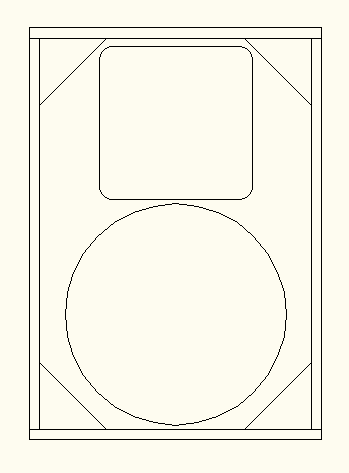 This is done to scale in Autocad. Basically each triangle has half the area of one of the original two ports, the idea being that I'll just put a little shelf going back the same distance as in the orignal design behind each one (112mm). Firstly, would that work... does the number of ports make any difference or is it the total area that matters? i.e. if you only wanted an 18mm port depth could you just drill the right amount of holes the right width in it? That's the B&C ME90 in there by the way, the XT1464 was only just too high. I've had a go at modelling the original X15 in WinISD, but I'm not sure about the numbers it's giving me. Firstly, are these params right for the driver: 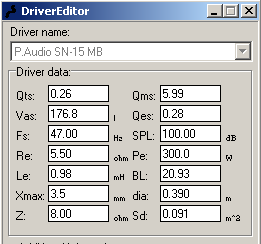 I've set the rest of the values up as follows: Driver ------- Number of drivers: 1 Normal Box ----- Vented Volume: 100 litres Tuning freq: 50 Hz Vents ------- Number: 2 Shape: rectangular Vent diameter: 0.231 x 0.060 metres Vent length: 0.220m Vent mach: 0.03 Now, the vents on the original design are 130mm deep, so what's going on here? have I put some values in wrong... is WinISD giving a different number than Rog might have come up with via other means... or is the fact that the box is a trapezoid shape somehow taken in to account in Rog's calculations (something I thought of afterwards) which of course means that the apeture inside the box is smaller than that of the baffle. Re. my new design, I want to keep the same box volume because I want to be able to use them as full-range speakers... is that right? i.e. does the volume affect the low-end response? There are so many questions and variables going round in my head it's hard to keep track of them! I feel like I'm jumping in a the deep end and not knowing what's going on a bit... any answers / suggestions welcome! Phil |
|
|
|
|
ceharden
The 10,000 Points Club
Joined: 05 June 2005 Location: Southampton Status: Offline Points: 11851 |
Post Options
Thanks(0)
Quote Reply
Posted: 03 February 2009 at 9:13pm |
|
Firstly, download WinISD Pro Alpha, it's much better....
You're heading along the right lines. If you can, model the ports as four separate ones if you can because it does make a small but noticable difference to the tuning frequency. Personally I think you could probably get away with two ports at the bottom, just make them a little larger and shorten them to keep the tuning the same. Or, you could do them the same as EV Deltamax and put two slot ports, one either side of the horn. Building triangular ports in a trapezoid cab are a bit of a head f**k when it comes to cutting the pieces! But stick with it, you're doing ok and I think you'll pick it up quickly. |
|
|
|
|
nickyburnell
Old Croc 
Joined: 06 February 2005 Status: Offline Points: 4408 |
Post Options
Thanks(0)
Quote Reply
Posted: 04 February 2009 at 12:02am |
|
Those traingle ports are OK for a square cab, think about doing the port duct though, even if you did just a bottom shelf and side shelf to the triangle, the port would taper in with the sides. Keep the ports away from the sides. Like this
Another way is to rear port, like Mach 15's. Or a simple port at the bottom all the way accross, the shelf would be the same (11 degree)? angle at its sides, if you get what I mean?
Edited by nickyburnell - 04 February 2009 at 12:05am |
|
|
It's everything, not everythink!
|
|
|
|
|
ceharden
The 10,000 Points Club
Joined: 05 June 2005 Location: Southampton Status: Offline Points: 11851 |
Post Options
Thanks(0)
Quote Reply
Posted: 04 February 2009 at 12:16am |
|
We're trying to get away from having a shelf port at the bottom as per the X15 plans because that takes up baffle height to fit a larger horn in. There's nothing wrong with having a port against the side of a cab as long as you're aware you will gain effective length and make the port slightly shorter than the calculations.
|
|
|
|
|
Phil.2008
Registered User
Joined: 10 July 2008 Location: Stamford, UK Status: Offline Points: 331 |
Post Options
Thanks(0)
Quote Reply
Posted: 04 February 2009 at 12:21pm |
|
It'd be a lot easier if I could make 18mm-deep ports like the X12. I understand this could affect response at higher SPL's though? What do people think?
This is the paragraph that I read about this (from http://www.hometheaterhifi.com/volume_5_2/cmilleressayporting.html): In addition, the size of the port itself, regardless of tuning frequency, can have quite an effect. A small port, although it does not have to be very long, must move a lot of air through a very small opening. This make turbulence more of a difficult thing to cope with. But, it also makes for a more non-linear resistance to air movement. In other words, as output increases, the resistance to air flow increases, and the benefits of a port decrease, making the output look more like a leaky sealed system. The larger the port, the less it happens, but the characteristic is always there. Very large ports, say 4 inches wide, will be FAR more linear in this regard than a port, say 1 inch in diameter. However, as the surface area doubles, the required length doubles as well, so that a port 4 times wider in diameter, which has an opening 16 times greater in surface area, must be 16 times as long to maintain the same tuned frequency. On top of that, large ports may suffer from pipe resonance (like a pipe organ) which can be really annoying. Edited by Phil.2008 - 04 February 2009 at 3:10pm |
|
|
|
|
Deadbeat
Old Croc
Joined: 12 March 2008 Location: Singularity Status: Offline Points: 3167 |
Post Options
Thanks(0)
Quote Reply
Posted: 04 February 2009 at 1:49pm |
|
Just don't take the piss with port size and length and you'll be fine. Check airflow graphs on winisd, and adjust length correction coefficients (do a search on this). Impedance plot at the measurement stage will reveal the real tuning.
|
|
|
Away on extended leave.
|
|
|
|
|
Phil.2008
Registered User
Joined: 10 July 2008 Location: Stamford, UK Status: Offline Points: 331 |
Post Options
Thanks(0)
Quote Reply
Posted: 04 February 2009 at 3:41pm |
|
OK, how does this sound (from Win ISD):
2 Vents at 270mm x 30mm, 131mm port depth Should give tuning frequency of 50Hz and maximum port air velocity of 1.5 (whatever unit that is) at 50Hz And looks like this: 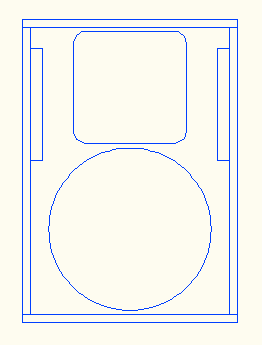 If someone could check the WinISD file I'd really appreciate it: www.philreeve.com/X15.wpr By the way I'm planning on making ports parallel to the side wall so that they're the same area all the way down. Looking at the diagram it might be nicer if I made them a bit wider horizontally and shorter vertically but have I got it basically right? Thanks Edit: updated WinISD file as I had the driver params wrong Edited by Phil.2008 - 04 February 2009 at 5:53pm |
|
|
|
|
ceharden
The 10,000 Points Club
Joined: 05 June 2005 Location: Southampton Status: Offline Points: 11851 |
Post Options
Thanks(0)
Quote Reply
Posted: 04 February 2009 at 7:30pm |
|
Hi Phil,
Looking pretty good. When designing ports like this I usually work from the length backwards. I would say the longest port you'd want to put in the cab is about 2/3 of the depth otherwise it gets too close to the back panel. It's easy to then work out using WinISD what the port area needs to be to get the tuning you want. Regarding end correction a shelf port as in your picture above will gain quite a lot of effective extension. In WinISD set it to be flanged at both ends, then on top of that I would probably calculate the tuning as about 5Hz higher than you actually want it. Aim for 55-60Hz and you'll probably get 50-55Hz. My preference is also to make the ports as square as possible. You want to maximise the area of the port while keeping the circumference to a minimum to avoid friction of the air against the wood. In your case, leave enough width either side of the horn to put a batten for grill support then make the port width fill the remaining space. Adjust the height to get the tuning. You're definitely getting close.... Chris |
|
|
|
|
Post Reply
|
Page 12> |
| Tweet |
| Forum Jump | Forum Permissions You cannot post new topics in this forum You cannot reply to topics in this forum You cannot delete your posts in this forum You cannot edit your posts in this forum You cannot create polls in this forum You cannot vote in polls in this forum |


 Topic Options