
|
Methods of reducing driver temperature |
Post Reply 
|
Page <1234> |
| Author | ||
snowflake 
Old Croc 
Joined: 29 December 2004 Location: Bristol Status: Offline Points: 3443 |
 Post Options Post Options
 Thanks(0) Thanks(0)
 Quote Reply Quote Reply
 Posted: 19 October 2023 at 10:30pm Posted: 19 October 2023 at 10:30pm |
|
|
you could put a big coil of copper tube inside the rear chamber with an inlet and outlet on the access panel. then you have the option of blowing either air or water through the coil. maybe precool your air through another coil in a water butt. easy to measure the temp difference between the inlet and the outlet and the flow rate to calculate how much heat you are removing.
|
||
 |
||
|
Lucasdude
Young Croc 
Joined: 16 March 2013 Location: London Status: Offline Points: 986 |
Post Options
Thanks(0)
Quote Reply
Posted: 20 October 2023 at 2:45pm |
|
Edited by Lucasdude - 20 October 2023 at 2:47pm |
||
|
||
|
JonB67
Young Croc
Joined: 22 April 2016 Location: UK Status: Offline Points: 1352 |
Post Options
Thanks(0)
Quote Reply
Posted: 20 October 2023 at 8:46pm |
|
|
Isnt this what volt speakers radial technology is supposed to help with? Any idea how well it works?
|
||
|
||
|
infrasound
Old Croc
Joined: 13 May 2011 Location: Brizzle Status: Offline Points: 2273 |
Post Options
Thanks(0)
Quote Reply
Posted: 20 October 2023 at 9:37pm |
|
|
From what I know the realhorns use a chiller unit, so with a suitable coolant it's entirely feasible that they use sub 0 degree coolant. I have seen images of a large 3ph refrigerant unit. Bonkers.
Don't know what RC1 use, although I would be interested to see. I would hazard a guess at a radial coolant jacket, as is common in BL motors / EVs alongside some heat exchangers and a nice big fan   |
||
|
||
|
Teadub
Registered User 
Joined: 13 April 2019 Location: Highlamds Status: Offline Points: 46 |
Post Options
Thanks(0)
Quote Reply
Posted: 21 October 2023 at 7:47am |
|
|
Scott hinson's sub of doom is springing to mind for me. Maybe have a look at that design, in the meantime though could you cut/build a port on each hatch that was tuned slightly out of band? Seems like a very small port gives more turbulence which itself aids air exchange. Pretty sure the output of the ports in Scot's sub of doom we're pretty much inaudible and just there for cooling
|
||
|
||
|
Lucasdude
Young Croc
Joined: 16 March 2013 Location: London Status: Offline Points: 986 |
Post Options
Thanks(0)
Quote Reply
Posted: 21 October 2023 at 10:12am |
|
I had 4 of the 15s when they came out about 30 years ago. I think they were 3853. They looked great, and had a nice tone to them, but I couldn't make them work for sub duty. I tried them in a few different cabs ( all I had to work from back then was "Loudspeaker design and construction" from Eminence.) Maybe the design just didn't allow for as much cone area as traditional designs, and I think the 500w claim from a 3" coil was a little unrealistic at the time. My PD1550s were way better.
|
||
|
||
|
snowflake
Old Croc
Joined: 29 December 2004 Location: Bristol Status: Offline Points: 3443 |
Post Options
Thanks(0)
Quote Reply
Posted: 22 October 2023 at 5:26pm |
|
one way to make ports less audible is to put them on the rear of the speaker. In a lot of designs this also makes the path length for radiation from front and rear of driver to the front of the box roughly equal which helps with summation and group delay. This could be done on Scott Hinson's design by putting port tubes from the rear chamber - through the horn path - and out the back of the cabinet. If they are small they won't reduce the cross section of the horn too much. |
||
|
||
|
fudge22
Registered User
Joined: 26 July 2022 Location: UK Status: Offline Points: 263 |
Post Options
Thanks(0)
Quote Reply
Posted: 23 October 2023 at 11:07pm |
|
|
Doesn’t anyone ever use internet search engines? It is not as though no-one has ever thought about this before. There are numerous articles and papers available discussing the measurement and computer simulation of voice coil temperature and thermal compression, as well as methods to improve cooling, so it should be easy to find some useful information on the topic. Here are a few, in no particular order, to start with: M. R. Gander, "Dynamic Linearity and Power Compression
in Moving·Coil Loudspeakers” J. Eargle, "Dynamic Compression in Studio Monitor
Loudspeakers" C. A. Henricksen, " Heat-Transfer Mechanisms in
Loudspeakers: Analysis, Measurement, and Design" T. S. Hsu & K. A. Poornima, “Temperature Prediction of a
Voice Coil of a Moving Coil Loudspeaker by Computer Simulation” A. J Hill, “Voice coil temperature in loudspeaker
performance: Causes, effects and prevention techniques” D. J. Button, “Heat Dissipation and Power Compression in
Loudspeakers” R. Bortoni, “Real-Time Voice-Coil Temperature and Cone
Displacement Control of Loudspeakers” The other factor to consider is the mechanical limitations of the drive unit. Assuming an effective, practical method to cool the voice coil can be implemented, how much more output will be obtained before excessive cone/coil movement becomes the limiting factor? At greater amplitudes, the cone suspension becomes less linear, and the coil may start to move outside the magnetic field. So, if the drive unit designer has optimised all parameters to limit at about the same time, improving the performance of just one won’t help much. Before cutting holes in any panels, be aware that that the enclosure volume behind the drive unit may have been optimised for maximum power transfer; look up reactance annulling. It may have not, you would need to ask the designer of the cabinet, but be aware that attempting to vent the enclosure might result in greater losses than gains. You could always try it with the cover removed, which would make it a front-rear loaded horn. if you have the time, money and inclination, go for it, but
at least do some research on what has been done before, and understand the
consequences of any changes that you make. p.s. Some of the above papers are published by the AES. If
you search for them the top results take you to the AES site, where they will
be very happy to relieve you of your hard-earned cash in exchange for a copy.
Move on. Many papers are available from the author, or the company they work
for, free of charge. Anyone with access to a college library will probably be
able to get them there. |
||
|
||
|
APC321
Young Croc
Joined: 24 August 2013 Location: West Midlands Status: Offline Points: 797 |
Post Options
Thanks(0)
Quote Reply
Posted: 25 October 2023 at 4:42pm |
|
|
Was stripping down a bass bin today which I bought recently.
The Gauss driver inside had wadding placed over the magnet structure. The magnet structure had got so hot that it had left an imprint on the wadding. The driver still works fine. I wonder what temperature the voice coil reached? 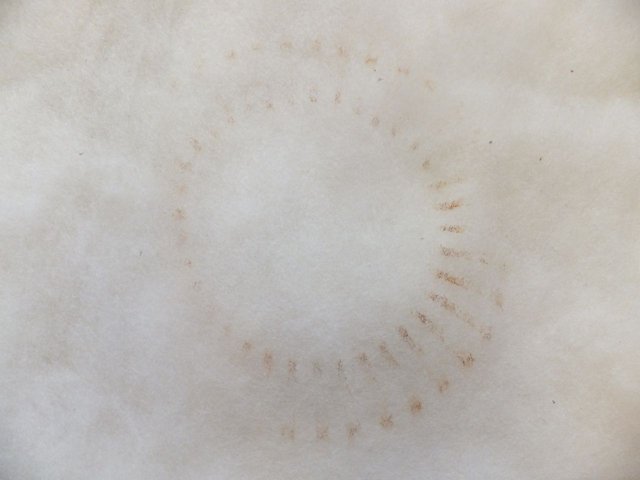
|
||
|
||
|
FOO
Young Croc

Joined: 23 December 2018 Location: Denmark Status: Offline Points: 953 |
Post Options
Thanks(0)
Quote Reply
Posted: 25 October 2023 at 5:46pm |
|
|
Sure its not rust from the motor? It could look like it.
|
||
|
||
|
Earplug
Old Croc
Joined: 03 January 2012 Location: Europe Status: Offline Points: 7752 |
Post Options
Thanks(0)
Quote Reply
Posted: 25 October 2023 at 6:23pm |
|
|
Aye, looks more like rust. The cover/heatsink on those did rust all the time. And the best way to avoid overheating your drivers is take enough gear to cover the gig!  |
||
|
Earplugs Are For Wimps!
|
||
|
||
|
APC321
Young Croc
Joined: 24 August 2013 Location: West Midlands Status: Offline Points: 797 |
Post Options
Thanks(0)
Quote Reply
Posted: 25 October 2023 at 6:59pm |
|
|
Fairplay, was rushing today, rust it is.
Wasn't a box I've used before. I definitely do not underspec when I do gigs! |
||
|
||
|
Post Reply
|
Page <1234> |
| Tweet |
| Forum Jump | Forum Permissions You cannot post new topics in this forum You cannot reply to topics in this forum You cannot delete your posts in this forum You cannot edit your posts in this forum You cannot create polls in this forum You cannot vote in polls in this forum |


 Topic Options
 jbl_man wrote: