
|
PD-224 Dual 24" Subwoofer |
Post Reply 
|
| Author | ||||
JimDR 
New Member 

Joined: 15 October 2025 Location: Belgium Status: Offline Points: 3 |
 Post Options Post Options
 Thanks(0) Thanks(0)
 Quote Reply Quote Reply
 Topic: PD-224 Dual 24" Subwoofer Topic: PD-224 Dual 24" SubwooferPosted: 15 October 2025 at 3:50pm |
|||
|
< ="WebKit-mso-list-quirks-style">
Hello! So, I’m working on my own system, made primarily for dub music but open to all electronic genres. I don’t have much experience in this field, but I want to learn a lot more about it, this forum has helped me a lot with this in the last year. Now that I finally gathered the funds, I’m ready to start building. I have a question about sub-bass, that I hope you will be able to help me with. In my search for a perfect subwoofer (crossover to kick at 70hz), I recently stumbled upon a cabinet design that I’m really intrigued by. https://www.precision-devices.com/wp-content/uploads/2023/11/PD-224-6th-Order-Plans-141123.pdf This cabinet designed by Precision Devices utilizes two of the PD.24603BR, the 24-inch woofers. Now I read all the forums and discussions I could find on this specific driver, as well as 24-inch drivers in general, and the opinions are conflicted at best… I’ve read so many different opinions about driver size and what their impact is that I can’t make out what to believe anymore. Some people say using multiple ‘smaller’ drivers like 18 inches has a better effect, while other people believe the complete opposite. So, my questions are the following: - Are there advantages to using 24-inch drivers over smaller ones and is this driver in specific something worth to take a risk at, please note that price is not of the essence for this. I gathered enough to pay for these drivers, and I am willing to do so if it’s worth it.
- This cabinet design is relatively new, and I couldn’t find anyone who has built it or even has an opinion on them online. Can anyone with experience in cabinet design please take a look at the plans and tell me if they have any doubts or red flags you notice that I should be aware of?
- Would I be better off with an alternative like the 18sound plans for the double 21NLW9600 or the new Stakx X221 subwoofer (links to both below).
https://www.eighteensound.it/media/W1siZiIsIjIwMTgvMTAvMjMvMTFfNDlfMzRfNDY4XzE4c291bmRfZG91YmxlXzIxX2tpdC5wZGYiXV0 http://stakx.be/media/pages/legacy/subwoofer/x221/35e0cf5a31-1741781581/x221_rev0_specsheet.pdf
Any opinions/help you can offer me is greatly appreciated, thank you! :)
Edited by JimDR - 15 October 2025 at 3:52pm |
||||
 |
||||
|
fudge22
Registered User 
Joined: 26 July 2022 Location: UK Status: Offline Points: 263 |
Post Options
Thanks(0)
Quote Reply
Posted: 16 October 2025 at 7:41pm |
|||
If you really want to learn, there are thousands of books and papers on-line which will give you some understanding of how loudspeakers work. I can suggest a few titles if you like. However, if you don’t want to get into mathematics, it might be useful to learn one of the free loudspeaker modelling programs. For sealed and reflex designs winisd is free and easy to use. It is ideal for comparing different drive units before buying. If you just want someone to advise you which is best, be prepared for conflicting opinions, or not if you want a specific review. Neither Chatgpt nor Grok could find any user feedback. This is niche design for a niche drive unit, I wouldn’t expect may to be out there.
Just like there is no spoon, there is no perfect subwoofer. Cost, portability, ease of set up and, does the system have to pay for itself? All these factors, and more, can influence the choice for a given situation. It is not unusual to see designs where aesthetics are prioritised over acoustics or some change in layout is used to enable the designer to claim some degree of originality of design. Just because I, or anyone else, prioritises one aspect of the design above another, doesn’t mean that priority is correct for you.
It is unlikely that Precision Devices would publish a design that didn’t work reasonably well. That said, it might be worth going over the plans. The drive units appear to fit in from the front, facing into the centre manifold. If the vertical brace is fixed in position, I can’t see how the drive units can be fit. The gap either side is about 180mm and the specs say that the drive unit is 250mm deep. There is no mention in the plans how this should be attached.
This drive unit is optimised for output rather than extended range. Its low frequency cut off is no lower than plenty of 12” -18” drive units, it just gets louder. Unless you intend to use them for reasonably large gigs, the output is wasted. Trade some of that raw output for smaller drivers that will go just as low, take up less room and cost far less. Alternatively look at drivers orientated for home theatre use which tend to be optimised for extended frequency response but get less loud overall (relative to 140+dB). Thonmann has a price of £1175 per drive unit, so presumably something similar in Euros. Personally, for me. spending that much per drive unit is crazy, unless specified in a commercial project; especially when you consider the cost for the rest of the system, which you don’t mention. However, it is not my money, and you did say that price was not a consideration, so if this is a personal project do what makes you happy. |
||||
|
||||
|
VECTORDJ
Young Croc 

Joined: 11 June 2006 Location: United States Status: Offline Points: 585 |
Post Options
Thanks(0)
Quote Reply
Posted: 16 October 2025 at 10:57pm |
|||
|
Dual 24s should be outstanding below 70 Hz....Go for it!!!!!
|
||||
|
||||
|
JimDR
New Member
Joined: 15 October 2025 Location: Belgium Status: Offline Points: 3 |
Post Options
Thanks(0)
Quote Reply
Posted: 16 October 2025 at 11:02pm |
|||
|
I read a few books already on the topic: The Sound Reinforcement Handbook by Gary Davis, Sound Systems: Design and Optimization by McCarthy and most recently Between The Lines by Michael Lawrence. Reading these gave me a (very) basic understanding of Soundsystem principles but I still want to learn so much more. if you have any other recommended reading material that would be fantastic! I feel like I still miss a lot of basic information to be able to fully understand and learn from this forum.
Regarding Loudspeaker modeling programs, I dabbled around with them a bit, but I need to spend more time actually learning to use them, I'll definitely start exploring that more and trying to figure it out, thanks! Regarding price, I planned (and saved) really long for cabs with the 18sound 21NLW9601 originally. When I stumbled upon the PD-24 the price wasn't that big of a difference, thus I became really intrigued. But after reading more about them, I became a little bit spooked. I have to admit that the factor of trying a new design, that Isn't widespread at all, really spoke to me as well. But obviously for this kind of money that's a risk that's probably not worth taking. Thank you very much for you clear and helpful response! |
||||
|
||||
|
Teadub
Registered User
Joined: 13 April 2019 Location: Highlamds Status: Online Points: 46 |
Post Options
Thanks(0)
Quote Reply
Posted: 17 October 2025 at 8:06pm |
|||
|
That cabinet seems to be tuned pretty high for such a big driver, there are plenty of other designs out there that will make loads of noise at 50 hz and they'll cost much less and be easier to move about.
I reckon big ole single reflex boxes, tuned in the mid to high 20s, massive ports and plenty of bracing, would be lovely. It would be worth modelling these in a 6th order bandpass as well, have a look at the X1 for layout. Failing that Ricci's skram is a safe bet |
||||
|
||||
|
fudge22
Registered User
Joined: 26 July 2022 Location: UK Status: Offline Points: 263 |
Post Options
Thanks(0)
Quote Reply
Posted: 17 October 2025 at 10:39pm |
|||
They get loud, but the bass extension is only down to 40Hz. For general purpose PA systems in large venues, this is a fine drive unit. If you don’t need the levels that this drive unit is capable of, it is not the best choice. There are plenty of smaller drive units that can go just a low, need smaller enclosures and cost less. Given that the response graph with the plans states that it is predicted (it looks like a plot from hornresp) it could be that this design is still untried.
The plans describe it as 6th order Here are a few comparisons. All designs have two drive units. 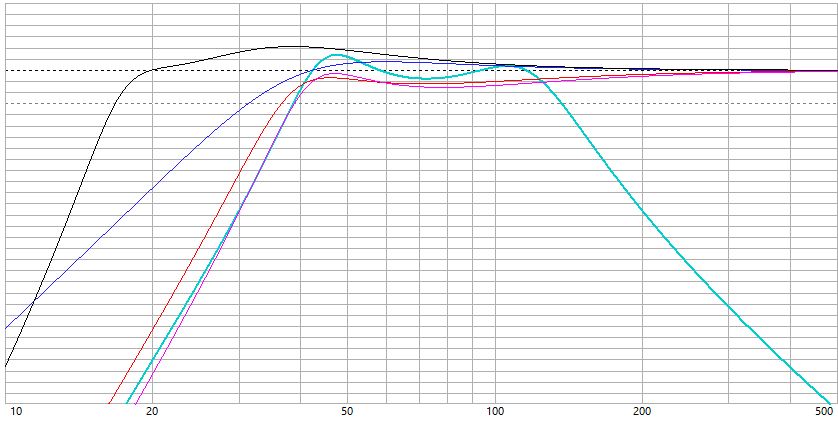 The turquoise is the PD24 modelled as 6th order bandpass the total cabinet vol’ is 720ltrs. My main aim was to try and match the response curve of the original design. The red curve is the same PD24 in a 600ltr reflex cabinet tuned to 38Hz The pink curve is a 12” FaitalPro driver in an 80ltr reflex cabinet tuned to 42Hz The purple curve is a 15” Dayton Audio Ultimax in a 250ltr closed cabinet The black curve is the same Dayton Audio in a 500ltr reflex cabinet tuned to 20Hz The predicted maximum SPL shows the monstrous output from the 24” drive units 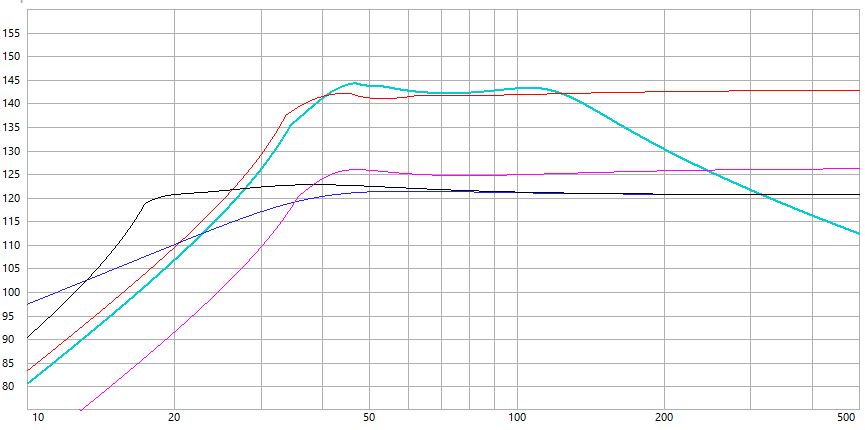
The books that you read are more about setting up and tuning loudspeakers rather than actual design of loudspeakers. I must admit to only having skimmed through "Between the Lines", and leave it at that. The three books on the shelf of anyone who claims to know about loudspeaker design should be, Acoustical Engineering by Harry Olson, which was always considered the bible on internet forum, Acoustics, by Leo Beranek, which I would put above for its in-depth analysis of enclosure design. I presume that these are probably out of copyright by now so should be available on the internet archive. Both these predate Thiele and Small’s work so there are no references to T/S parameters. An updated version of Beranek’s book has been published titled Acoustics: Sound Fields and Transducers. There are thousands of academic papers but they usually discuss a specific topics, so it is difficult to recommend anything in particular. However, Richard Small’s series of papers on closed and vented boxes are worth reading. |
||||
|
||||
|
DMorison
Old Croc 
Joined: 14 March 2007 Location: Aberdeen Status: Offline Points: 1740 |
Post Options
Thanks(0)
Quote Reply
Posted: 18 October 2025 at 2:33pm |
|||
Page 22 of the plan states "Remove for driver loading" so presumably it is meant to be screwed in only and not glued, FWIW. That does seem like a recipe for future rattling if the screws work loose, however.
|
||||
|
||||
|
Post Reply
|
|
| Tweet |
| Forum Jump | Forum Permissions You cannot post new topics in this forum You cannot reply to topics in this forum You cannot delete your posts in this forum You cannot edit your posts in this forum You cannot create polls in this forum You cannot vote in polls in this forum |


 Topic Options
 I don’t have much experience in this field, but I want to learn a lot more about it