slot port design
Printed From: Speakerplans.com
Category: Plans
Forum Name: Ported Enclosures
Forum Description: Post all your reflex and bandpass and 'other' boxes with holes in stuff here...
URL: https://forum.speakerplans.com/forum_posts.asp?TID=107278
Printed Date: 27 March 2026 at 6:38am
Software Version: Web Wiz Forums 12.08 - https://www.webwizforums.com
Topic: slot port design
Posted By: snowflake
Subject: slot port design
Date Posted: 10 August 2022 at 4:05pm
|
Hi I'm trying to design a port for a double 15" ported horn using B&C 15DS115. 190L volume 500cm2 port cross section and 25cm port length gives a tuning of about 40Hz and port speed of about 40m/s. So it needs to be flared to reduce the port noise.
cabinet is 57cm wide so one option is to have a slot port that is 57cm*8cm and flared with a large radius (~4cm) along the long edges at each end. other option is to make a wider (57cm*16cm) slot out of two parallel pieces of 18mm and then used curved ply in between these to create a flare in the other direction that would be 26.5cm*16cm at the narrowest point. anyone able to say which of these will have lower port noise? |
Replies:
Posted By: fatfreddiescat
Date Posted: 11 August 2022 at 8:57am
|
Probably not a lot in it between the two options I guess. Circular or square port cross sections should have lower resistance which suggests the second option. The first option is the type favoured by L Acoustics and others, possible advantages are an increase in end correction due to two walls of the port extending the full depth of the cabinet, possibly allowing for the same tuning with a larger open area or a shorter port length, it also has a larger area of the port profiled which should help, plus better cooling for the drivers when the cab is laid on it's side. Is it possible to fit the ports as 'cassette' modules? Would allow for future retuning etc. Re port noise, I don't think that will be an issue with this cab as the overall output will be so high it will mask the port noise, the main issue I think will be the port choking and so transitioning to a sealed rear chamber design, this can be measured easily although bloomin loud with that cab
 |
Posted By: Elliot Thompson
Date Posted: 16 August 2022 at 12:50pm
|
Slot ports generally offer less turbulence noise than circular ports. The issue is not the type of port but, the loudspeaker itself. When the loudspeaker is incapable of producing sound from the voice coil in which, the excursion is the main source of reproducing the sound at the given frequencies, you will encounter a lot of turbulence noise. The key is finding the right loudspeaker (based on the TS Parameters) that will achieve the lower frequencies desired without relying heavily on excursion. Bear in mind Xmax has nothing to do with the measured TS Parameters. Focus on loudspeakers designed for Reflex & Horn cabinets and not solely Horns. Best Regards,
------------- Elliot Thompson |
Posted By: snowflake
Date Posted: 16 August 2022 at 7:26pm
there aren't many very high xmax drivers to choose between. the 15SW115 has a higher qts but wants a much larger horn throat and rear chamber. In the same enclosure as I've designed for the DS the SW is limited to lower output 40Hz-50Hz by it's xmax |
 Elliot Thompson wrote:
Posted By: Elliot Thompson
Date Posted: 17 August 2022 at 1:21am
The problem is the B&C 15DS115 will never take advantage of the rear chamber to attain 50 Hz much less 40 Hz. It is designed to offer a lot of 60 Hz on up. That is what the TS Parameters is saying. You need a balance amongst the two. Disregard the horn for the moment and just scale the rear chamber in which, the driver will be sitting in with the port. In other words, scale a reflex cabinet with the desired port to determine if driver can achieve 50 Hz - 40 Hz @ -3dB. If your first -3dB point is around 80 Hz - 60 Hz, you have already loss half of your amplifier power trying to achieve 60 Hz. Matters will be worse if you are trying to reach to 40 Hz. The TS Parameters and the Free Air Graph speaks for itself. The speaker is -10 dB @ 60 Hz from a starting point of 95 Hz. With a driver offering a Qts of 0.17 and a VAS of 3.32 Cubic Feet.... 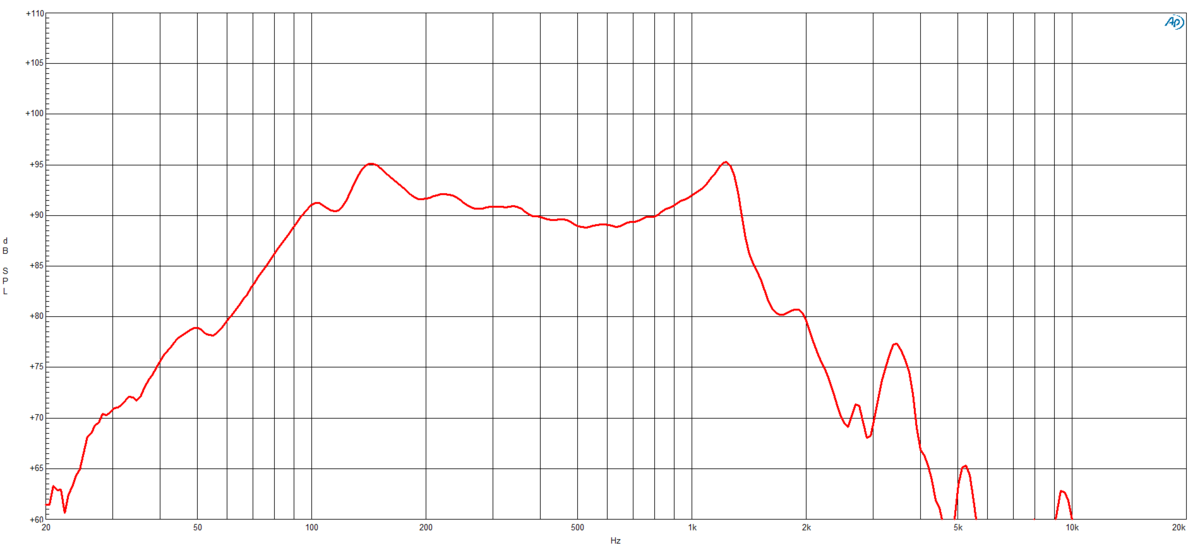 Best Regards, ------------- Elliot Thompson |
Posted By: toastyghost
Date Posted: 17 August 2022 at 9:14am
This is going to be the trade-off, unfortunately. The DS series of drivers was originally developed to provide a higher BL at a lower unit cost than the SW, and appears to have been made possible primarily due to tooling improvements that resulted from a large manufacturer’s order requirements. The SW might need more breathing room for the horn element, but they're very effective in even relatively small ported enclosures. Check the B&C 215-DCX reference design as an example; it has an unprocessed on-axis -3dB point of 50Hz from two 15SW115 in separate enclosures of approximately 120 litres each, with a slot port of 204 x 180 x 180 mm on either side of each driver.  I'm not sure what your target overall cabinet size is, but you might be able to give a little more space to the horn with a similar arrangement. A horn throat with lower compression ratio will generally sound better at full chat, anyway. That might be useful - the horn's low pass filtering effect can mask the nastiest throat distortions, but they may instead be audible through the diaphragm and out via the port. |
Posted By: snowflake
Date Posted: 17 August 2022 at 12:37pm
|
just noticed the 15DS115 spec sheet recommends a rear volume of 80L and tuning of 40Hz - which by coincidence is exactly what I arrived at to give suitable rear chamber for the horn and a vented chamber that can have a 40Hz tuned port that isn't ridiculously long. The lossy Le model in hornresp adjusts the BL for the 15DS115 to 28 which implies a qts of 0.3 - doesn't that mean this driver is more suitable for vented than spec sheet qts suggests? the compression ratio on my horn is very high but the horn flare is 65Hz 0.7T with symmetrical throat loading and a rapid flare in the first 10cm. DS115 should be robust enough to deal with that. pushing things in terms of throat distortion at full ouput though, ~1W/cm2 @200Hz means ~4% air distortion. I would prefer lower but a lot of speakers are worse than that due to motor and suspension non-linearities. |
Posted By: Elliot Thompson
Date Posted: 18 August 2022 at 2:00am
It does not. This is due to the Le being based on 1 kHz on up. It does not play a factor from 100 Hz down. I have no idea how much this driver will cost you. In the States, the street price is nearly $700 for one driver. There are other options (Eighteen Sound, Faital Pro, RCF, BMS) that would take advantage of the rear chamber to achieve a better low frequency extension that would be a fraction of the cost. So there is no reason to limit yourself only to B&C. Reflex cabinets rely on VAS, fs and, Qts to achieve optimum results as it uses the rear wave of the driver to amplify sound (Loading in the internal chamber of the cabinet). Horn drivers follow the opposite principal using the front wave of the driver to amplify sound (Loading in the Horn). This is why a driver suited for both types of cabinets will give you the best of both worlds. Realistically, a medium between the two. Best Regards, ------------- Elliot Thompson |
Posted By: toastyghost
Date Posted: 18 August 2022 at 8:46am
A relatively unknown fella called W. Marshall Leach would strongly disagree with you: https://leachlegacy.ece.gatech.edu/papers/vcinduc.pdf" rel="nofollow - https://leachlegacy.ece.gatech.edu/papers/vcinduc.pdf There are further examples, plus a MathCAD script for the modelling method used in Hornresp ,from Plantefeve here - use a translator: http://jm.plantefeve.pagesperso-orange.fr/acou.html" rel="nofollow - http://jm.plantefeve.pagesperso-orange.fr/acou.html Le is typically reported on driver marketing spec sheets at 1 kHz, but it varies with frequency & is dependent on the excursion. Some driver manufacturers such as Scanspeak share the results of two models publicly, others require you to ask for the full .kdbx file from Klippel Analyzsr. L(x) and Li(x) are nonlinear parameters reported by a LSI3 test, which is based on these standards that Klippel contributed to: IEC 60268-5 Sound System Equipment, Part 5: Loudspeakers IEC 62458 Sound System Equipment – Electroacoustic Transducers - Measurement of Large Signal Parameters They have a lovely illustrated poster about nonlinearities in loudspeakers too, with a section for Le(x) and Le(i): https://www.klippel.de/fileadmin/_migrated/content_uploads/Klippel_Nonlinearity_Poster.pdf" rel="nofollow - https://www.klippel.de/fileadmin/_migrated/content_uploads/Klippel_Nonlinearity_Poster.pdf It's too big to screenshot and share here, but if you click one link on this post - make it this one ☝️ I think people sometimes put a bit too much weight on the Hornresp Lossy Le results - it is a nonlinear parameter in a linear model, after all - but it absolutely has an effect on Bl and more in the real world. |
Posted By: Elliot Thompson
Date Posted: 18 August 2022 at 11:58am
|
Bear in mind that I measure loudspeakers in which I have the capability to select the starting and ending points. You will not achieve an Le response from 100 Hz down. This is why people disregard Le for Bass applications.
The biggest problem is using a horn method topology on a reflex concept. It just creates confusion for those who have very little understanding on achieving optimum results designing a reflex box. Best Regards, Best Regards,
------------- Elliot Thompson |
Posted By: toastyghost
Date Posted: 18 August 2022 at 12:42pm
|
Oh, is this another post where you’re just going to ignore a whole pile of evidence showing that you’re wrong? Cool; obviously you’re a much more established engineer of renown & contribution than Leach & Klippel 
|
Posted By: snowflake
Date Posted: 18 August 2022 at 1:12pm
|
it's not really a reflex box though - I'm only getting the port output so the response of the rear chamber doesn't really matter like it does with a reflex design. The only thing that seems to affect port output level significantly is the motor strength - which implies low qts drivers are better! And the Sd affects the q of the port output - larger drivers giving a broader port output peak. the rolloff of the horn+chamber is mainly governed by the reactance annulling of the horn. EDIT: higher motor strength also gives more group delay I've just realised that if the effective BL is reduced due to lossy Le then my reactance annulling calculations might be well off  Maybe there is a driver with a strong motor and high xmax but lower Le... Maybe there is a driver with a strong motor and high xmax but lower Le..."I think people sometimes put a bit too much weight on the Hornresp Lossy Le results - it is a nonlinear parameter in a linear model, after all - but it absolutely has an effect on Bl and more in the real world." will bear this in mind 
|
Posted By: Elliot Thompson
Date Posted: 19 August 2022 at 11:29am
Actually, I put more trust in Eminence that has made loudspeakers for nearly 60 years, in addition to my own measured results through LIMP. However, if you can show me a measured result of an Le response from 100 Hz down I will stand corrected. Are you game? Best Regards,
------------- Elliot Thompson |
Posted By: Elliot Thompson
Date Posted: 19 August 2022 at 11:31am
That is a Reflex. Best Regards, ------------- Elliot Thompson |
Posted By: fatfreddiescat
Date Posted: 19 August 2022 at 11:43am
Eminence, a company that put THEIR trust in Klippel
|
Posted By: Elliot Thompson
Date Posted: 19 August 2022 at 11:53am
Yet, no one is debating...
In which, I stated...
Continue.... ------------- Elliot Thompson |
Posted By: fatfreddiescat
Date Posted: 19 August 2022 at 1:21pm
The info from Eminence is correct but it isn't the whole story re motor behaviour as explained in the info Toasty has linked to. It appears it becomes relevant when Le is of a similar or higher value than Re as is the case in some large VC drivers.
|
Posted By: Elliot Thompson
Date Posted: 20 August 2022 at 10:12am
That does not play a factor when you are using a tuned port at 40 Hz - 50 Hz as snowflake is considering. The port is going to activate at the tuning frequency. I understand where you are coming from. However, you are still looking at things from a Horn's perspective. Reflex follows a different principal. Once you port a horn to extend the low frequency response, you are essentially using a combination of a horn and reflex box. By doing so, any frequencies that falls within the port's tuning needs to follow the reflex topology in order to achieve optimum results. Hence VAS, fs and, Qts are the vital numbers. Best Regards, ------------- Elliot Thompson |
Posted By: snowflake
Date Posted: 20 August 2022 at 11:46am
Fs Qts and Vas can be used to determine reflex alignments that have a desired response. But take the horn away from my design and sim it as a vented rear chamber and you get a huge peak at the port frequency - it's not any recognised alignment. So what use are t/s parameters selecting a driver for a ported horn? |
Posted By: toastyghost
Date Posted: 20 August 2022 at 6:32pm
All of Klippel’s work is based on sealed and ported enclosures you might realise that if you read any of it
|
Posted By: Contour
Date Posted: 21 August 2022 at 8:36am
| Slot ports mostly have an advantage above round ports because they are using the cabinet walls and often have larger cross section (and length). For equal cross section I personally prefer round ports with large flares. For example the Intertechnik Jetset series. |
Posted By: snowflake
Date Posted: 21 August 2022 at 10:40am
I've never seen a flared port bigger than 100mm though and with these drivers need more than that. |
Posted By: Contour
Date Posted: 21 August 2022 at 11:17am
| You can use more, but I agree, with large drivers the advantage is shifting to slot port, also much cheaper. |