Query for Reconing Techs
Printed From: Speakerplans.com
Category: General
Forum Name: Electro Frying Forum
Forum Description: Talk about drivers, processors and mixers
URL: https://forum.speakerplans.com/forum_posts.asp?TID=108955
Printed Date: 26 March 2026 at 5:30pm
Software Version: Web Wiz Forums 12.08 - https://www.webwizforums.com
Topic: Query for Reconing Techs
Posted By: AJ113
Subject: Query for Reconing Techs
Date Posted: 23 February 2025 at 9:32am
|
In your experience, when drivers are fried, which is the most common cause: amps clipping or thermal overload/excessive excursion? |
Replies:
Posted By: VECTORDJ
Date Posted: 23 February 2025 at 1:15pm
| GROSS OVERPOWING.....The REAL Power Handling of a Woofer is Pink Noise for an extended Time (RMS).....This Number is many Times too low for the Sales Depart so They Rate it at Peak for 1/10000 of a Second...You will get more Sound by adding more Woofers than by playing a Woofer many Times RMS....1/10000 of a Second is a very short Song....Send Your Blown Woofers to VECTORSONICS for Recone Work... |
Posted By: AJ113
Date Posted: 23 February 2025 at 4:07pm
|
OK thank you. My subs are rated 600w (8R) and the power amps are (allegedly) 700w per channel. They work quite well together but the amps peak too much and I am concerned about possible sine wave damage. (I don't think they are outputting 700w, even at peak) I'm wondering if I will get better results, and if it will be better for the equipment to run in bridge mode coupling two subs in parallel per amp. The alleged output bridged is 2900w into 4R, obviously too high at 1450w per cab, but I'm thinking if I keep the input level sensible, this mode of operation might be better for both amps and drivers. Assuming no more than 1200w per cab as a result of optimistic marketing and keeping the input level low, as far as I know that is about right for amp-power-to-driver ratio. |
Posted By: Conanski
Date Posted: 23 February 2025 at 10:30pm
|
If you're frying drivers with a 700w amp then you're going to do it even faster with twice as much power behind them. Bridging into 4ohms is harder on an amp. Lowering level controls does nothing to limit output power. What processing do you have to protect the speakers? If the answer to that is nothing that is your problem.
|
Posted By: AJ113
Date Posted: 23 February 2025 at 10:38pm
|
I'm not frying drivers; I'm looking to optimise my operation. "Lowering level controls does nothing to limit output power." If the input is reduced, isn't the output also reduced? "What processing do you have to protect the speakers? If the answer to that is nothing that is your problem." It's crossed over at the appropriate frequency; I also high pass the masters (belt and braces), plus the amps have limiters. |
Posted By: Conanski
Date Posted: 24 February 2025 at 2:29am
|
 AJ113 wrote:
Posted By: jacethebase
Date Posted: 24 February 2025 at 10:52am
|
Funktion One have a very simple Limiter Calculator on their website that may help you https://funktion-one.com/calculators/" rel="nofollow - https://funktion-one.com/calculators/ Also this book was a life send to me when I was starting out trying to figure out what is what. Its probably fairly out dated now with regards to modern DSP etc but covers the basics. https://www.amazon.co.uk/Sound-Reinforcement-Handbook-Gary-Davis/dp/0881889008/ref=asc_df_0881889008?mcid=d3da3f36968234afa4706578ebdcead9&tag=googshopuk-21&linkCode=df0&hvadid=697315520135&hvpos=&hvnetw=g&hvrand=15080627225776730211&hvpone=&hvptwo=&hvqmt=&hvdev=c&hvdvcmdl=&hvlocint=&hvlocphy=1007199&hvtargid=pla-489942567335&psc=1&gad_source=1" rel="nofollow - https://www.amazon.co.uk/Sound-Reinforcement-Handbook-Gary-Davis/dp/0881889008/ref=asc_df_0881889008?mcid=d3da3f36968234afa4706578ebdcead9&tag=googshopuk-21&linkCode=df0&hvadid=697315520135&hvpos=&hvnetw=g&hvrand=15080627225776730211&hvpone=&hvptwo=&hvqmt=&hvdev=c&hvdvcmdl=&hvlocint=&hvlocphy=1007199&hvtargid=pla-489942567335&psc=1&gad_source=1 ------------- www.wedding-production.co.uk www.stage2sound.com |
Posted By: Line Array
Date Posted: 25 March 2025 at 1:13pm
not a reconing tech, but the way clipping kills speakers is it sends distortion into the tweeters killing them. if you aren't using passive tops clipping isn't that big a deal.
|
Posted By: RoadRunnersDust
Date Posted: 16 April 2025 at 5:11am
You are describing "Program" there. RMS would be a continuous signal such as a sine wave. ------------- www.guildfordcablecompany.co.uk" rel="nofollow - www.guildfordcablecompany.co.uk |
Posted By: AJ113
Date Posted: 16 April 2025 at 7:15am
| Isn't pink noise a continuous signal? |
Posted By: RoadRunnersDust
Date Posted: 16 April 2025 at 8:14am
|
No, and once you start getting into it it becomes harder to explain because the old style power ratings were based on essentially arbitrary figures and not very accurately named to boot! Essentially the old term "RMS" means "low crest factor signal" where the peak to RMS amplitude ratio is incredibly small. It's also been intended to mean things like "continuous power" or "average power". It never had a unified standard for how it was measured or what it meant but if you take it to mean "you can feed the speaker a sine wave of this power and it will be safe" then you're usually not far wrong with it. Meanwhile pink noise has a crest factor of 4 meaning that the peak amplitude of the signal is +12dB greater than the RMS (Root Mean Square) amplitude of the signal. This gives you a signal that behaves more like music in terms of it's amplitude whilst the "pink" part of it means that the energy is equally distributed per octave (meaning 20-40Hz has the same amount of energy in pink noise as the 200-400Hz band does). This also better represents a music signal compared to a sine wave which has *all* of it's energy at one frequency. There's a reason all the reputable manufacturers have moved over to the AES standard for loudspeaker power rating  ------------- www.guildfordcablecompany.co.uk" rel="nofollow - www.guildfordcablecompany.co.uk |
Posted By: AJ113
Date Posted: 16 April 2025 at 8:27am
|
Well I have to say I'm none the wiser in terms real-world application. On their website, Crown Amps specifically advise amps that are rated up to 2.5 times(!) the speaker rating. Surely they must know a thing or two about amps and speakers? I've gone ahead and bought a couple of QSC 1850HD which will deliver a reliable 1850 watts per side in bridge mode. I am assuming this will give me a bit of headroom on my 1200-watt pairs and allow me to operate at optimum level, especially since QSC's rating is based on a short burst at 1kHz, so probably not a true 1800 watts. If I fry the drivers, well, I've learned the hard way. Edit: typos |
Posted By: RoadRunnersDust
Date Posted: 16 April 2025 at 8:33am
|
2.5 is slightly excessive but not ridiculous... That suggestion usually comes with the caveat that proper limiting, etc. is in place. 2x the amplifier power is +3dB of signal. The general rule of thumb I have seen most people work to is that the amplifier's "RMS" rating should be roughly equal to the speaker's "Program" rating. That way you can run the speaker right up to it's "peak" rating (with appropriate limiters, etc.) safely whilst not pushing the amplifier all the way to it's maximum at the same time. The more important rule of thumb that goes along with that though is that if you need to push you speakers so hard that you're hitting peak rating or limiters then you should have taken more speakers to the show... ------------- www.guildfordcablecompany.co.uk" rel="nofollow - www.guildfordcablecompany.co.uk |
Posted By: AJ113
Date Posted: 16 April 2025 at 8:42am
|
"The more important rule of thumb that goes along with that though is
that if you need to push you speakers so hard that you're hitting peak
rating or limiters then you should have taken more speakers to the show." Yes of course. However, I'm a one-man-band with limited storage and transportation - and a limited back. So I'm trying to be as compact and efficient as possible. The key for me is not to accept gigs that my PA can't handle. |
Posted By: RoadRunnersDust
Date Posted: 16 April 2025 at 8:51am
 ------------- www.guildfordcablecompany.co.uk" rel="nofollow - www.guildfordcablecompany.co.uk |
Posted By: madboffin
Date Posted: 16 April 2025 at 6:33pm
|
I have long retired but when I was working with large (festival and touring) systems I always set the crossover limiters just below the clip point of the amplifiers. I don't remember blowing any speakers... If you drive a speaker with square waves from a heavily clipped amplifier it will be getting more power than you might expect from the amplifier's specified maximum output, which is for an undistorted signal. Speaker failures are normally due to burnt out voice coils caused by excessive power, and damage due to over excursion is relatively rare. Having said that, I once had to investigate a pile of bass bins that came back from a festival with a couple of dozen failed 15" drivers. The system tech (not me, I wasn't there) had failed to set up the limiters properly, the LF amplifiers were Macrotech 3600s, and the last act of the event was Prodigy. If you aren't old enough to have seen or "experienced" them, well, they were notoriously loud and their music produced a lot of low end... All the bad speakers had been driven well beyond their xmax and had crumpled coil formers and damaged neck joints. Those 3600's could produce a lot of peak power. An expensive mistake.
|
Posted By: AJ113
Date Posted: 16 April 2025 at 10:40pm
|
"I have long retired but when I was working with large (festival and
touring) systems I always set the crossover limiters just below the clip
point of the amplifiers. I don't remember blowing any speakers..." Doesn't really address the issue. The question is what should the power rating of the amp be in comparison to the rating of the speakers. An amp's limiter will kick in at the onset of clip, but if the amp's output is five times that of the rated power of the speaker it's essentially irrelevant - at least to this particular discussion. |
Posted By: RoadRunnersDust
Date Posted: 17 April 2025 at 1:54am
That is due to crest factor. It’s 1AM so the following may be completely wrong but: Prodigy’s music, as an example, generally has a crest factor of 4 to 10 or 12-20dB. This would mean that a Crown 3600 bridged into an 8R driver (3,140W if we believe the spec sheet) with limiters set just below clip ought to give about 4kW of peak output but when the peak limiters are just being met the RMS output would be 15-100x less than peak so only 266-40W RMS. 266W is still no inconsiderable amount of power when you consider drivers are lucky if they turn even 1% of that power into sound, the rest is turned into heat and the most important part of the music is in the peaks, they are the parts that get people dancing, etc. For reference, you can’t hold onto a 60W lightbulb without getting burnt It also goes to explain why even with such high power amplifiers as are available now, there’s not been *that* much of an increase in blown drivers or how you can run a “600W” TSW-721 on an MC2 E90 without much concern. The reality of crest factor of the signal means you need an amplifier with substantially higher peak output than would conventionally match with its “RMS” output. This is also why the cheaper modern Class D amplifiers still manage to perform so well when not pushed to their limits, they haven’t got the continuous power capacity of the high-end expensive touring amplifiers but as long as the crest factor of the music matches the peak and RMS capacities of amplifier they don’t run out of power. At least that’s as far as raw power goes, there’s plenty else you’re paying for with a professional amplifier! ------------- www.guildfordcablecompany.co.uk" rel="nofollow - www.guildfordcablecompany.co.uk |
Posted By: Line Array
Date Posted: 17 April 2025 at 2:55am
|
crest factor varies with frequency. it is higher for tweeters and lower for subs. especially with modern electronic music like dubstep ( not to be confused with dub ) bass is starting to turn into one continuous ( processed ) sinewave ... whereas treble remains dynamic in nature ( intermittent peaks ) this is happening because continuous HF energy would be fatiguing to listen to, on other hand bass subsystems are limited in output so to make best use of limited capacity bass is spread out in time to make sure you get the most bass out of whatever speakers / amps you have ... |
Posted By: RoadRunnersDust
Date Posted: 17 April 2025 at 3:43am
|
Yes, it does vary with frequency but due to the distribution of energy the crest factor of the low frequencies does not vary that much from the crest factor of the whole spectrum when analysing music. No, bass is not turning into continuous sine waves. That’s utter bullshit idiots have been repeating for the past 20-30 years. If you can’t tell the difference between a sine wave and what you hear in dubstep then you shouldn’t be commenting on anything to do with perception of low frequencies. Sinusoidal modulation ≠ sine wave signal.
Once again, nonsensical word salad to try presenting your opinion as a fact. What else should we expect from the illustrious Line Array🙄 ------------- www.guildfordcablecompany.co.uk" rel="nofollow - www.guildfordcablecompany.co.uk |
Posted By: Line Array
Date Posted: 17 April 2025 at 4:22am
do not get sad just because you will never understand anything i write. there are probably other joys in life other than learning from the great master. though i doubt they can compare. now for the higher life forms reading this the point is that in the past bass used to be basically a kick drum, which was a rather impulsive sound with a high peak and short duration. but now that bass is electronically synthesized it is less like a kick drum and more like a bass guitar note, so less peaky and more continuous. this is happening because subwoofer / amp power is available continuously, not in separate impulses like the power of a kick drum. in a loudness war a source that better aligns with the capability of the loudspeakers system will ultimately be louder and therefore win. with a vented box tuned to 30 hz if you want the loudest and deepest possible bass it will need to look a lot like bass guitar / synthesizer notes that bounce around 40 hz region and are fairly continuous in nature. although musicians do not understand the physics behind this they have ears and know what sounds rich and what sounds thin and flat. so through trial and error they are gradually converging on the mathematical inevitability which is obvious to a genius like me. much the same as how genetic evolution is blind and random and yet at any given time you know where it is headed. i have been looking at the FFT of various tracks in Adobe Audition and while it may not be an exact constant 40 hz sinewave it is not that far off ... it comes and goes, the frequency moves around from about 37 to maybe 50 hz, there is usually two or three harmonics etc. but it's definitely doing its best to minimize the crest factor ... high frequencies are not like this. the overall music energy is of course dominated by bass, but what does your blown tweeter care about overall music energy ? every frequency / amplification band has to be analyzed separately. overall music energy only matters for the circuit breaker your amps plug into. in essence both the recording medium ( Compact Disc ) and the playback system ( PA ) have more headroom in the highs, which is why there is more dynamics and a higher crest factor in the highs. not much headroom in the sub range and thus a lower crest factor. obviously it can't go down to zero or it won't be music anymore, but it will try.
|
Posted By: Jan-2T
Date Posted: 17 April 2025 at 7:55am
|
you dont listen to many genres do you... long bass is and has been in all music of all times, or should i really point out the long bass in this picture?  ------------- Music! |
Posted By: Line Array
Date Posted: 17 April 2025 at 8:10am
|
only serious SPL "long bass" in music used to be the Pipe Organ but i don't think anybody tried to record a pipe organ and then play it back through speakers at a concert the most powerful pipe organ in the world, coincidentally located here in New Jersey: https://en.wikipedia.org/wiki/Boardwalk_Hall_Auditorium_Organ" rel="nofollow - https://en.wikipedia.org/wiki/Boardwalk_Hall_Auditorium_Organ has blowers totaling 630 horsepower. i don't think the pesky humans in your picture can match that.
|
Posted By: RoadRunnersDust
Date Posted: 17 April 2025 at 8:42am
Two words that apply to you, Pal. “Dunning” and “Kruger”.
That is neither an accurate description of bass nor synthesised bass. It’s also completely inaccurate bullshit about its relationship to subwoofer or amplifier capacity, if anything the peak capacity of modern equipment is far greater compared to its continuous capacity than ever before. Everything I have seen you write on this forum since you popped up screams of someone that has little to no actual experience with much beyond entry level home audio equipment.
Apparently you don’t understand “loudness” either. It is already well understood that if you want perceived loudness and depth for bass then the critical range for the ear is with the second harmonics. Continuous bass notes also sound substantially less “loud” to general human perception than repeated notes due to the way the brain interprets the envelope of sound well but magnitude generally very poorly.
Despite the opposite being generally true…
I’m amazed a “genius” like you managed to achieve that given how an FFT shows you spectral information and nothing about waveform shape nor *anything* in the time domain.
Harmonics have little to do with envelope and so little to do with crest factor.
Completely missing the point that was clearly made. To repeat it again as you seem to need a second attempt at understanding: Overall music energy was relevant to the conversation, before you stuck your less than informed oar in, as the difference between the full spectrum crest factor and the low end crest factor is usually insignificant. This is due to the low end of the spectrum naturally having the most significant peak and RMS amplitude of the signal. Since the mid and upper ranges of the spectrum generally don’t contribute as much to the peak amplitude or drastically change the RMS amplitude when added to the isolated low end of the spectrum it serves no purpose to obfuscate the topic of conversation by addressing it.
And yet there is demonstrably greater dynamic range in the low end on in music produced for digital audio formats than there is found in any of the domestically available analogue mediums. PA systems also usually only have greater headroom in the upper range due to the nature of cabinet dispersion. It’s noticeable in the lower end of the audio industry when there is often only a single source for Mid/HF on either side that the greater system headroom is usually found in the low end. The reason the upper registers have greater crest factor in music is and always has been due to natural energy distribution and the spectral sensitivity of the human ear. it has never been driven by the capability of the system, only the other way round.[/QUOTE] And no, it can’t go down to zero since it is a ratio of RMS:Peak amplitude. It cannot go below 1. Surely a “genius” ought to understand that enough to not make such an inaccurate observation ------------- www.guildfordcablecompany.co.uk" rel="nofollow - www.guildfordcablecompany.co.uk |
Posted By: Line Array
Date Posted: 17 April 2025 at 9:39am
thank you for unwittingly proving my point. amplifiers and music are both converging toward each other. in the past music was dynamic but amplifiers were not able to take advantage of this. today amplifiers are designed to exploit the fact that music has crest factor but the crest factor is getting crushed by loudness wars compressing everything. both are a good thing. that is to say music and amps both started out in a vacuum but have become aware of each other and are gradually finding a common ground.
care to elaborate ?
indeed being a genius helps. but not as much as having multiple engineering degrees and having studied digital signal processing. square wave, triangular wave etc. will have different harmonic profiles that will show up on FFT. but that wasn't my point. my point is that a square or triangle wave will break down into sinewaves most of which will get sent to the woofer, but the fundamental will be sent to the subwoofer, so as far as a subwoofer is concerned - it's a sinewave, regardless of what it started out with. the question is whether this sinewave is continuous or intermittent ... 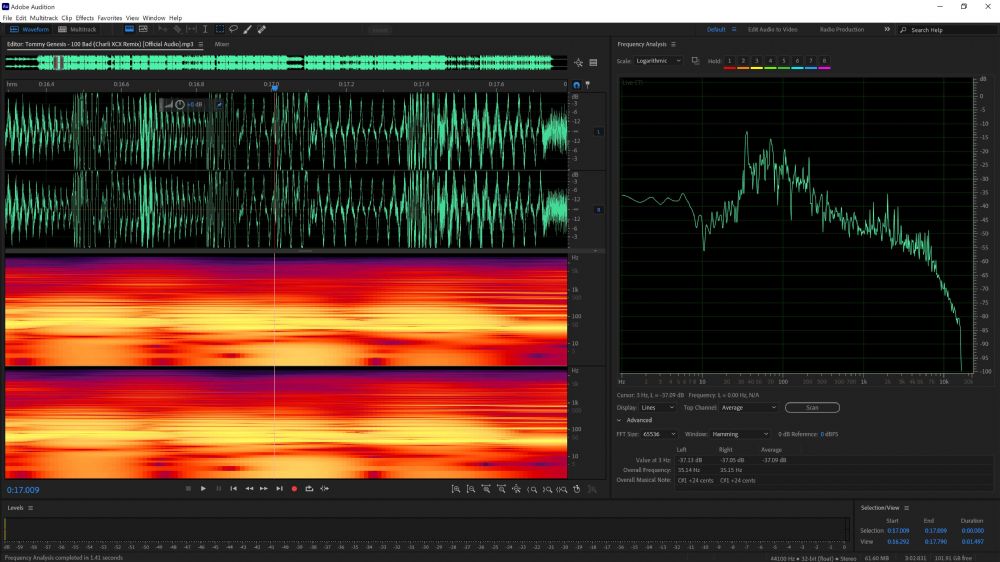 looks pretty continuous to me ! basically one gigantic 35 hz sinewave with some noise, distortion and other modulation added to it. here is the track in question: https://youtu.be/7U5QxwcWbv0?si=B2lP05Zf26fYRvJL
if it's the same genre of music i am sure it is true. but most people who go to concerts are younger folks and don't listen to 50 year old music.
it is due to the physical nature of sound. lower frequencies are produced by physically larger phenomena that tend to move more slowly. a twig that snaps when you step on it is a high frequency sound that is very short because the twig is light. a wave crashing on a beach is a low frequency sound that is long because the wave is very heavy.
as a genius i have the benefit of understanding that crest factor can also be expressed in decibels in which case it can go to 0.
|
Posted By: Line Array
Date Posted: 17 April 2025 at 10:20am
i already regret making what will probably be my most broadband insulting comment i have made in 30 years of debating audio on the internet but here it comes ... if 2nd harmonic determines the loudness of your bass then your system simply doesn't play the fundamental loud enough because it can't. i am running close to 30 decibels of bass boost on Equalizer APO software into my Bose 700 headphones: 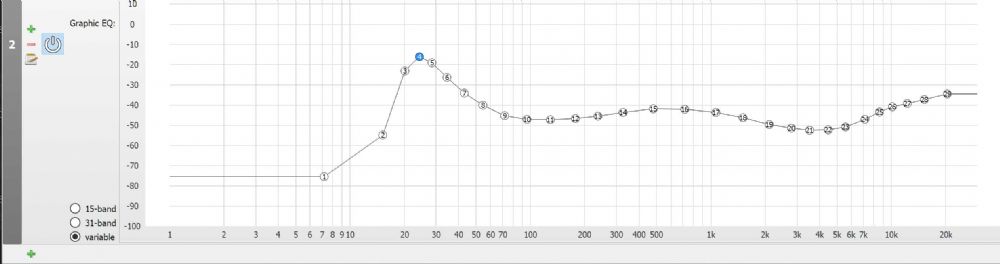 these headphones have their own DSP ( as well as pressure sensor based servo feedback like PowerSoft i-Pal ) in them and thus already have pretty accurate / deep bass, but i am throwing another 30 decibels of bass boost on top of that because i can ... that's what gives me a somewhat uncomfortably loud bass in the 30 hz area which is what i like ... now in the track i linked in my previous post cutting 35 hz on Equalizer APO sucks the life out of that track ... it goes from having wicked deep borderline painful bass to ... well ... not having any bass. why does this happen ? because with my custom EQ curve the fundamental was LOUD ENOUGH to carry the track. of course if your subs begin to roll off at 50 hz and the fundamental is at 35 hz and you cut it - you won't notice much difference - because it was never loud enough to matter in the first place. but that's not because you can't hear 35 hz. it's because you didn't EQ for the Equal Loudness contours like i have. granted in headphones that is free bass. with PA subs it would quadruple the cost of your system to run that EQ curve. but my super duper horn sub design that is part of the super duper array system design are designed to reproduce precisely the same kind of EQ curve that i am already running on my headphones. that is the design is to run enough sub-bass boost to match Equal Loudness curves, which is way beyond the standard house curve. if you had that level of bass boost in the 30 hz area the idea that fundamental doesn't matter would fall apart ... in other words what you call science ( the whole missing fundamental concept ) is probably just cope ... because it is not feasible for you to reproduce the fundamental at 10 decibels above the level of 2nd harmonic ( which you would have to do given equal loudness curves ) you simply say that it doesn't matter. because it really doesn't if you can only play it at same SPL as the 2nd harmonic, in which case due to Equal Loudness curves ( formerly Fletcher Munson Curves ) the 2nd harmonic will mask the fundamental. so it's not that i don't know science. it's that your subwoofer is not big enough. don't cry now. LOL
|
Posted By: RoadRunnersDust
Date Posted: 17 April 2025 at 11:33am
|
This guy You’re talking about headphones and the bottom two octaves like that doesn’t *completely* devalue any comment you have to make about sub/bass reproduction. At this point I’m convinced you’ve never been in the same postcode as a system capable of reaching below 30Hz let alone owned one. At no point did I say the fundamental has no effect or cannot be heard, I repeated the well known feature of human hearing that the 2nd harmonic has more to do with perceived loudness than the fundamental. Loudness has *nothing* to do with SPL. The idea that you think 30dB of boost is achieving anything of practical or positive result is hilarious though  ------------- www.guildfordcablecompany.co.uk" rel="nofollow - www.guildfordcablecompany.co.uk |
Posted By: RoadRunnersDust
Date Posted: 17 April 2025 at 11:37am
As to your previous post, I’m out so I’ll address it later but suffice to say that your back-peddling, point-dodging and self-contradiction are all tell tale signs of someone caught bullshitting  ------------- www.guildfordcablecompany.co.uk" rel="nofollow - www.guildfordcablecompany.co.uk |
Posted By: fatfreddiescat
Date Posted: 18 April 2025 at 9:30pm
Was that an EAW850 system by any chance? If not, it wasn't the only time the Prodigy system didn't survive the night.
|
Posted By: madboffin
Date Posted: 18 April 2025 at 10:13pm
No, it was an F2. But I know it wasn't the only rig to suffer that fate. The warehouse manager had a nice trip to ATC at Aston Down with twenty-something L1540s for them to recone. They had a big laugh when someone in the hire company's office (again, not me) asked them if it was a warranty job... Funny thing is, the reason I wasn't looking after that job was because I was working as system tech for another company, with an almost identical system at another festival. Prodigy also played that one. The limiter lights on the crossovers were flashing all through the show, but none of the clip lights on the amplifiers were, and yes I was watching *very* closely. All the speakers survived... |