Damping material in scoops
Printed From: Speakerplans.com
Category: Plans
Forum Name: Scoops
Forum Description: One scoop or two ;-)
URL: https://forum.speakerplans.com/forum_posts.asp?TID=109231
Printed Date: 27 March 2026 at 6:53am
Software Version: Web Wiz Forums 12.08 - https://www.webwizforums.com
Topic: Damping material in scoops
Posted By: JPF
Subject: Damping material in scoops
Date Posted: 17 September 2025 at 4:30pm
|
Hi, I am writing to see if we couls share some impresions about damping materials in scoops. There are some desings that advice to use damping material on certain areas of the chamber. Said that, dambing material in general works for mid and high frecuencies, so does it make sense to use it in a scoop which works in a range of 35-80 hz? I am asking this because I have at the moment a couple of scoops that have poliurethan foam 120 kg/m3 density and 2cm thick as a damping material and I dont know if it brings any banefit. My concerns are: - Does this material reduce the volume of the chamber? - Does it affect the tonality and how the scoop perform in the low frecuencies? - Is it worth to have it in and leave it as it is? if not what would you do, replace it by other more suitable material or just remove it? I would like to know your opinions. Many thanks in advance JPF
|
Replies:
Posted By: Tinnitus Rex
Date Posted: 17 September 2025 at 6:26pm
|
I also can see no purpose for "damping" a box or cavity with wadding at below 200hz .. unless its to keep the driver warm. ------------- "couldn't we just like... use headphones?" |
Posted By: teeth
Date Posted: 17 September 2025 at 8:24pm
| i would recommend using 18mm plywood as a damping material |
Posted By: Conanski
Date Posted: 17 September 2025 at 10:44pm
The function of damping materials in non sealed box sub designs is to control any out of band resonances that may result from the cabinet or driver, the audible difference between damping or no damping should be pretty subtle in most cases. There is no harm in trying a box without damping, you may or may not hear much difference.
|
 JPF wrote:
Posted By: fatfreddiescat
Date Posted: 18 September 2025 at 7:41am
|
Can you not just remove the foam from one of them and check the result? As mentioned in the previous post. Maybe double up the damping in the other?
IIRC L Acoustics don't use damping in their K28, other manufacturers do with a slight loss of LF. If you have ever noticed, a completely empty room echoes a lot, move even a small amount of soft furnishings into it and the sound changes substantially. In this case, it is more like standing outside the room with the door ajar. With no damping, low level sounds which in themselves would be masked if they're damped, tend to be more noticable if they're allowed to ring for a significant length of time. Think upper harmonics, IMD and suspension and other mechanical sounds ringing, may or may noy not regard it as objectionable.
|
Posted By: Meat Substitute
Date Posted: 18 September 2025 at 9:19am
|
Never tried scoops with wadding myself but did a test with some ES18 a few years ago. The sound was noticeably better and tighter with the wadding. In that case we added a LOT of wadding. It's probably more important for upper bass As Fatfreddiescat says above it's my understanding that the main measurable effect of wadding is in the time domain rather than in frequency response and that the effects of changing the volume of the chamber will be less than you might expect. Also agree with the comments about cooling. If the wadding affects the airflow to the vents then that's a problem and you're signing up to greater power compression and lower thermal limits. The change in thermal conductivity of the chamber is likely a very small effect in a vented chamber like a scoop where the main heat transfer out of the driver will be convective and the thermal conductivity of wood is quite bad anyway. The only way to see for sure is to try it but I think you'll want to be trying to measure time domain (waterfall/impulse) type responses rather than the frequency response to see the biggest differences.
|
Posted By: Tinnitus Rex
Date Posted: 18 September 2025 at 6:13pm
|
With the room filling energy of a sub bass bin at gig levels the resonances of the room would be very difficult damp with any material let alone inside a little box by using some fluffy stuff. As mentioned adding stiffening or bracing to a box would be higher on the list of micro improvements... but as the room/space that it is used in is the biggest enemy of its performance , it is the very least of its worries.
------------- "couldn't we just like... use headphones?" |
Posted By: Lucasdude
Date Posted: 18 September 2025 at 6:24pm
| Scoops were some of the first bins I built myself in the early 90s. The only damping I ended up using was on the panel directly behind the driver, and it was just a few mms of bitumen from my car hifi installs called "brown bread". I didn't have any measurement capabilities back then, but to me it made the most sense to damp the panel exposed to the highest energy. Maybe it was just down to my poor construction abilities, but it sounded tighter and less resonant. |
Posted By: Tinnitus Rex
Date Posted: 18 September 2025 at 7:09pm
|
For mid hi the best thing would be for manufacturers to damp the chassis and magnet plate that is parallel to the back of the cone to stop inverted reflection off magnet going forward through the cone creating destructive interference ..... They dont bother much . but I can say 2" comps sound better if you damp the back cavity with dense denim fibre rather than the original foam that's glued on to most of them . But Low frequency wavelengths are way too big for this to work down at that scale .Energy absorption is directly proportional to density of material ..so bitumen or roofing rubber sheet would probably be as good as it gets .....Has anyone tried Sorbothane ? ------------- "couldn't we just like... use headphones?" |
Posted By: fudge22
Date Posted: 18 September 2025 at 9:08pm
If the resonance is out of band, there is no signal to excite the resonance, which is why the difference between with and without damping is, as you say, subtle.
If you have ever noticed, even a very small room is much larger than a typical loudspeaker, which is why you can actually fit in it, with or without furniture. If you use Sabine’s formula to calculate the approximate reverb time of a 200 ltr enclosure it comes out at about 0.15 seconds. Whether it is accurate at such small volumes I don’t know, but I doubt that reverb is a problem. At low frequencies a typical enclosure is probably too small for even resonant modes to exist so damping material will have little effect. For two way cabinets such as a 15/12 inch plus horn, mid-range resonances can have an impact on the response and damping material helps.
Completely filling the enclosure with wadding can, depending on who you speak to, lower the box Q (less resonant, more damped), making the cabinet behave as if it was slightly larger, slightly changes the speed of sound, changes the compression from being adiabatic towards being isothermal. They are all sort of intertwined.
A waterfall plot is displaying the frequency domain at a succession of discrete time intervals. When using FFT to display the response, the time and frequency domains are directly related, which is how one can be calculated from the other. Maybe somewhat pedantic, but if a certain professional sound forum can have multi-page threads because someone mentioned phase when they should have said polarity….
Possibly a placebo effect. We all convince ourselves that the latest modification has improved things.
The internet tells me that bitumen has a density of 1.25 gm/cc, concrete 2.5 gm/cc and steel 7.8 gm/cc. If absorption is directly proportional to density, leaving a steel speaker chassis uncovered should be best. For loudspeaker completeness, fibre board has a density of medium. To the OP the best way to determine the effectiveness of damping material is to experiment by measuring. It is a pain if you have to remove a drive unit every time you make a change, but one sometimes has to suffer for one’s art. Personally, I use a cut-off of 150Hz. If the loudspeaker is only used below 150Hz I don’t bother with wadding. If it goes above, and into the mid range. I measure first and if the response is uneven I experiment wadding before fiddling with the eq. |
Posted By: JPF
Date Posted: 23 September 2025 at 10:22am
|
Hi, Many thanks for your detailed and well-founded replies. Many (or most) people agree on using damping material, although the working frequencies of the box wouldn’t be directly affected. Thank you for the advice to test with and without material — that would certainly be the best approach. Here I’m posting a list of materials that are being used and recommended by some manufacturers, to hear your opinion on which would be the most suitable option:
There is quite a variety of them. What do you think about the nature of these materials, and their physical properties such as density and porosity? Manufacturers like 18 Sound recommend using high-density material such as Dacron for their box designs. At the moment I am using polyurethane foam agglomerated (~0.12 g/cm³ / 120 kg/m³) with 2 cm thickness to cover the walls of the chamber, and I’m afraid that such a high-density material could have negative effects, such as reducing the effective volume of the chamber or affecting the behavior of the lower frequencies. What are your thoughts on this? Many thanks in advance, |
Posted By: levyte357-
Date Posted: 23 September 2025 at 12:50pm
|
Some of the responses in this thread, clearly illustrate, why this post should be moved to the Scoop Forum.  ------------- Global Depopulation - Alive and Killing. |
Posted By: JPF
Date Posted: 23 September 2025 at 5:12pm
| Do you have anything positive to contribute to this topic? If not, it’s very rude to imply that there is something stupid in the opinions, answers, or information being politely exchanged among the other members. That kind of post clearly shows your own stupidity and desire for attention. |
Posted By: fudge22
Date Posted: 23 September 2025 at 9:37pm
First off, I understand that scoops work on some magical principle, that only the initiated understand. My comments therefore concern rear loaded horns; i.e. an enclosure where the back of the diaphragm is horn loaded, and the front of the diaphragm faces forward on a baffle, which has somewhat of a similar outward appearance to scoops. I may not be the best person to say how much of the following might be relevant to the OP's loudspeaker.
Option for what? What are you trying to achieve by adding or changing the damping material in your cabinet? Are you just adding it because you have read that it is needed? A solution can be better determined once the problem is known. The absorption properties of a material are not directly related to the density of the material. If sound absorption is the main criterion of your choice, the figure that you need is the sound absorption coefficient, in the frequency range required. I’m not sure about scoops, but the idea behind the rear loaded horn was to increase the efficiency at low frequencies where the natural response of the drive unit was rolling off. The enclosure can be split into three overlapping regions. At very low frequencies (just what frequency is considered low depends on the size of the horn mouth and horn length) the enclosure behaves like a transmission line. As the frequency rises the behaviour transitions into that of a horn. As the frequency continues to rise, the relative level of the front to rear radiation becomes closer and, where path length differences cause the signals to be out of phase, destructive interference and thus an uneven response ensues. It is not uncommon to see large dips in the response of rear loaded horns. The aim of a good design is to have the horn’s response to roll off before it gets to the point where interference occurs. This can be done either by designing the rear chamber, which acts as a shunt capacitor, to act as a low pass filter at an appropriate frequency **, adding a thin layer of absorbent material for the placebo effect, or setting the crossover frequency below that where the response starts to suffer. The latter sort of defeats the object of using a rear loaded horn, where the front facing drive unit is supposed to give a useful response into the mid range, which is the frequency range where any absorbent material behind the drive unit will have most effect. If your design suffers from an uneven response at the upper end of its range, given that destructive interference, from path length differences, occurs at discrete frequencies, the best form of absorption, in my opinion, would be resonant. I have never seen this done though, and never a fan of rear loaded horns, something I have never tried. Resonant absorption could be achieved by incorporating a resonant chamber close to the throat of the horn, which is tuned to the problematic frequency **, as shown below. Should anyone try such a thing you are on your own in experimental territory. 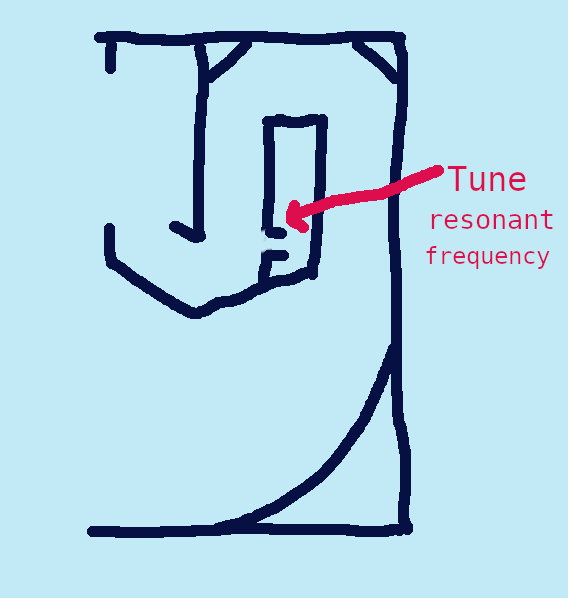 Anyone remember the Bassmax cabinet by Rhino Audio (if I remember correctly). It was like a rear loaded horn but with the drive unit in the back of the enclosure.
** I’d normally include the relevant formula, but I don’t think that they are applicable for scoops. |
Posted By: mint
Date Posted: 26 September 2025 at 4:31pm
| I believe the Hemholtz resonator was implemented in scoop by PCH Audio. How it works etc would have to be described by them. |
Posted By: fudge22
Date Posted: 26 September 2025 at 10:33pm
How it works, in the example I showed, is by attenuating the signal passing down the horn at the resonant frequency. The following diagram shows the transmission characteristics for electrical, mechanical and acoustical equivalents. It is from the book Dynamical Analogies, published in 1943. 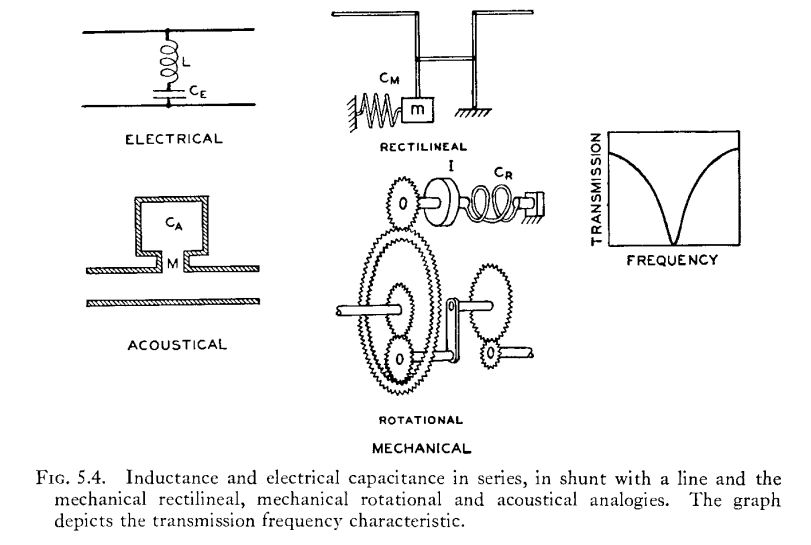 |
Posted By: Jcman1ey
Date Posted: 02 October 2025 at 10:41am
| cheers |