Single 12" or 15" tapped horn to pair with KHorns
Printed From: Speakerplans.com
Category: General
Forum Name: Newbie Discussion
Forum Description: Newbie Discussion/Questions. Look less stupid here...
URL: https://forum.speakerplans.com/forum_posts.asp?TID=109385
Printed Date: 26 March 2026 at 7:10pm
Software Version: Web Wiz Forums 12.08 - https://www.webwizforums.com
Topic: Single 12" or 15" tapped horn to pair with KHorns
Posted By: wellerfoolproof
Subject: Single 12" or 15" tapped horn to pair with KHorns
Date Posted: 07 January 2026 at 10:29pm
|
Hi there – I'm looking to incorporate a single sub into my home listening setup, which currently consists of two Klipschorns (AK3, if relevant). I'm very happy with the current setup, but frequently play dance music through it and would like to reinforce the low end somewhat. From reading online, the consensus seems to be that a tapped horn is the only option for integration with KHorns, so I'm looking at plans like the https://www.diysubwoofers.org/projects/other/POC3/" rel="nofollow - POC3 , https://www.diyaudio.com/community/threads/single-sheet-th-challenge.170771/" rel="nofollow - SS15 , https://www.diyaudio.com/community/threads/tham15-a-compact-15-tapped-horn.175658/" rel="nofollow - THAM15 , https://freespeakerplans.com/plans?view=article&id=24:mth-30&catid=14" rel="nofollow - MTH-30 , etc. Because of space constraints, I'm limited to a single sub with a max of about 19" or 20" width. My top priority outside of the size limitation would be low-end extension; efficiency would obviously be good, but since it's a home listening environment the SPL doesn't need to get too crazily high. Additionally, since the KHorns are pretty flat down to almost 50Hz, I could get away with a sub that doesn't go flat to too much higher than that ( https://forum.speakerplans.com/forum_posts.asp?TID=58675&PID=589566&title=fth12-tapped-horn#589566" rel="nofollow - like the FTH12 ), provided that the crossover from sub -> KHorn is steeply sloped. Of the above options (or any others that you're aware of), which would you recommend? Furthermore (and maybe more subjectively), is a single one of any of these enclosures likely to make a noticeable difference in low end reinforcement? If so, how should I be evaluating each option in terms of what I'm hoping to achieve? Do I want lowest Fs value, flattest slope towards roll-off, or something else? |
Replies:
Posted By: Larry23
Date Posted: 08 January 2026 at 4:53pm
|
I'm not sure why the consensus is that a tapped horn is the best solution, though they can be very effective subs. In a domestic environment, and with the size constraints you have, i would go for a sealed box, with something like one of the Dayton Audio Ultimax drivers. Or, if you crave more efficiency, seek out an appropriate PA driver (Lavoce and SB Audience both do some really solid, good vfm 15" and 18" drivers) A sealed box has the least group delay of any design, great impulse response and phase behaviour. With decent DSP and amp (not sure what you're planning on using?), you should find, along with room placement, that you can get seemless integration with the Klipschorns via this route.
|
Posted By: Contour
Date Posted: 08 January 2026 at 5:27pm
| Agree with the above. |
Posted By: monkeypuzzle
Date Posted: 08 January 2026 at 6:21pm
|
Also agree, if it's sub you want (good below 50) whilst a TH will do this, it's not the best option in terms of size. I have Tham 15s and whilst they do exactly what I want then to, I've seen and used smaller ported boxes that whilst don't go as loud, do drop lower. ------------- blah blah blah blah blah...... |
Posted By: Lucasdude
Date Posted: 08 January 2026 at 8:23pm
| What year are the AK3s? Have you tried adjusting the distance the cabinets are from the corners? They should have a pretty good bass response without a sub. A high quality eq unit with an adjustable high pass filter might allow you to increase the bass output above 35hz or so. You may struggle to integrate a subwoofer with those speakers. An open baffle dipole design might be worth researching. |
Posted By: Xoc1
Date Posted: 08 January 2026 at 8:49pm
|
The Tapped horns that you have mentioned are all optimised for PA use - That is to say they are tuned for loud rather than low. None of them are Subwoofers. There are a few exanples of low tuned tapped horns but because of the long path lengths needed they tend to be very big. https://www.cowanaudio.com/ These are also very old examples and probably need an update. 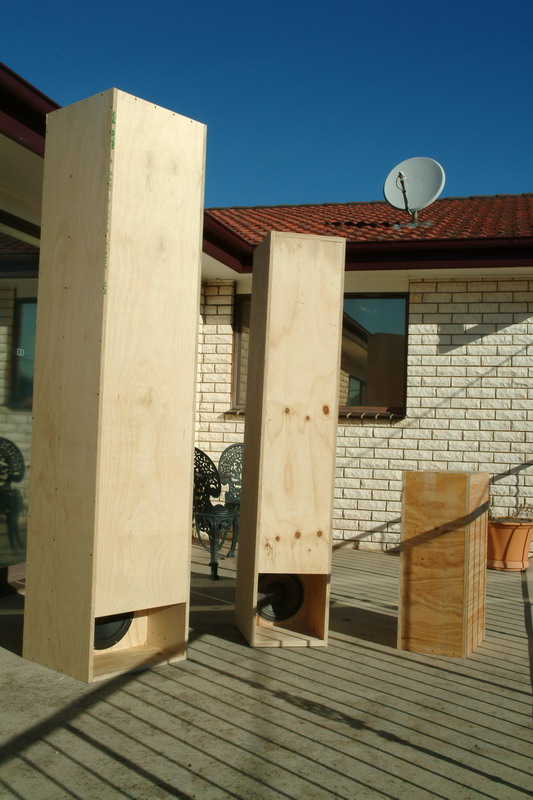 What sort of processing would you want to use to integrate a sub with your system?
|
Posted By: fudge22
Date Posted: 08 January 2026 at 9:41pm
|
The last time I heard Klipschorns was back in 1978, but I assumed that they were useful down to about 40Hz when corner loaded as designed for. To get anything lower will require a large enclosure, especially if the aim is for extra low output at party/dance levels. I was with Lucasdude all the way until he mentioned open baffle dipole. Anyway, to elaborate on some of the points mentioned. Tapped horns are not really true horns. The mouth size is too small. They are more like a quarter wavelength pipe. You can approximately estimate the low frequency response by dividing the speed of sound by 4 times the pipe length. The Tham15 you linked to, I would estimate to have an effective length of 1.8m which means a response down to about 344/(4*1.8) = 48Hz. To get anything that goes much lower than your existing Klipschorns would require a longer horn/pipe. If I remember correctly, William Cowan did a 30Hz design that had an effective length of over 3m. If you just want more output down to where your Klipschorns operate to, then the smaller (relative) cabinets will work. Regarding using a sealed box due to the superior group delay and phase response. These are closely related to the frequency amplitude response. A sealed box is modelled as a second order high-pass filter, compared to a reflex box being a fourth order filter. The lower roll off rate means a lower rate of phase change. If you use electronic filters (eq) to match the amplitude response the phase response will match too. Group delay is a derivative of the phase response, in that it plots the rate of change, or steepness of the graph, of the phase response. Higher order filters have steeper changes in both amplitude and phase. The Klipschorns are not likely to have a very flat phase response, and the low pass filter used on the sub will also introduce phase changes, so I wouldn’t worry too much. Coming back to the dipole. To get a flat response they need to boost the bass at a rate of +6dB/oct. To maintain constant sound pressure level a monopole needs to displace four times (+12 dB/oct) the air volume for every halving of frequency, but a dipole has to have eight times (+18 dB/oct) the displacement. Dipoles are great for testing the excursion limits of a drive unit. If you can find a drive unit that gives the low end extension in a sealed cabinet go for it, otherwise a reflex design is more than adequate. Given that brands like Quested, Genelec and ATC, mainly use bass reflex, there is a good chance that the audio that you listen to was recorded using reflex monitors. How successful they will be, will partly depend on your expectations. As an addendum. The photo Xoc1 posted shows the Cowan cabinets I mentioned above, which I wrote prior to his posting. It better shows the need for a long pipe. |