lower-mid horn design
Printed From: Speakerplans.com
Category: Plans
Forum Name: New Projects Forum
Forum Description: Forum for new speakerplans projects, in memory of Tony Wilkes, 1953 - 2014
URL: https://forum.speakerplans.com/forum_posts.asp?TID=623
Printed Date: 27 March 2026 at 12:39am
Software Version: Web Wiz Forums 12.08 - https://www.webwizforums.com
Topic: lower-mid horn design
Posted By: RayVaughn
Subject: lower-mid horn design
Date Posted: 24 September 2004 at 12:33pm
|
Currently the main weak point of our system is the lower mid range. I want to design a horn to cover this range and I'm happy to be radical with design and materials. The frequency range they need to cover is 150Hz to 1kHz although we may actually bring the top crossover point down an octave in practice. Our bass bins are similar to Turbosound TSW 118 and we typically use 6 or 9 per side. When we get our new amps the bass will be capable of 140dB (ish) at 1 meter as a maximum SPL. I'm guessing that it's ideal to design a horn that covers a wider range than it'll be used for so aiming for a good response from 100Hz to 2kHz is practical? Which horn flare is best for this range? Any thoughts on drivers? We're prepared to spend the cash to make these sound excellent. Thanks in advance, Ray Vaughn www.innerfield.co.uk ------------- --------------- Ray Vaughn and on www.innerfield.co.uk www.rocketfestival.com |
Replies:
Posted By: Pinheiro
Date Posted: 24 September 2004 at 12:50pm
|
Hi Ray to do one horn to cover 100hz to 2khz (single driver)is for me an no win plan try this HD15 from 80/100hz to 180/220hz and MT102 180hz to 16khz and you get one kick ass quad amp system but big and heavy or you can get some turbo aspect tops(i dot know if they are ok or not)or some flood flash to be on the safe side my take hope it helps yours Vitor |
Posted By: RayVaughn
Date Posted: 24 September 2004 at 1:26pm
Vitor, We've already got 18 bass bins - seems kinda pointless building HD15s which cover a similar range. We've also already got upper mids that we really like the sound of that are currently m 1kHz to 7kHz and tweeters that are loud and ok from 7k up. So you see it's a specific range that I want to cover. Of course I could go buy some bluse boxes but thats hardly in the spirit of this forum is it! thanks anyway ------------- --------------- Ray Vaughn and on www.innerfield.co.uk www.rocketfestival.com |
 Pinheiro wrote:
Posted By: Elliot Thompson
Date Posted: 24 September 2004 at 1:28pm
|
Hi If you're planning to build some horns, I recomend 100 Hz straight horn (Quarterwave of course!) with a 15 inch driver with a QTS of 0.2 - 0.26 Having around four of them fed with some good power (800+) should really get the job done. I'm currently using EAW KF 750's. But, I used to use some old 170 Hz straight horns. (4 of them) The total mouth of the combined four was 56 inches by 62 inches (2 high, 2 wide) They housed 18 inch drivers, but, I used the old EV Proline EVM 15L (no. 7.5%) instead. The low mids were very potent to say the least. Best Regards, ------------- Elliot Thompson |
Posted By: RayVaughn
Date Posted: 24 September 2004 at 1:48pm
Quarterwave - so the length of the horn needs to be more than 1/4 the wavelength? So 1m long is good? Why use a 15" driver though? There are some 2.5" and 3" voice coil 10" out there with good power handling (though not 800w continuous) and I'd be very worried about cone breakup at 1kHz with a 15". Here's the drivers I'm thinking of: Precision devices PD107 18 Sound 10ND610 JBL 2012H ------------- --------------- Ray Vaughn and on www.innerfield.co.uk www.rocketfestival.com |
Posted By: Elliot Thompson
Date Posted: 24 September 2004 at 2:05pm
|
RayVaughn Elliot Thompson Yes. that will be fine. RayVaughn Elliot Thompson You said "Low Midrange", so, it should be cutoff at 1khz (Least efficient). The majority the work will be coming from 500 - 150Hz, and, cutoff at 120 or 100 Hz. (Whichever sounds better) RayVaughn Elliot Thompson When I think of midrange, I think 10 inch drivers. When I think of Low Midrange/Midbass, 15 or 12 inch drivers comes to mind. I just don't think a 10 inch can handle frequencies under 400 Hz very well without cone breakup. Best Regards, ------------- Elliot Thompson |
Posted By: RayVaughn
Date Posted: 24 September 2004 at 2:35pm
I'm confused. For me 'cone break-up' is where the diaphragm stops acting as a piston and exhibits resonant modes across it. This is one reason why we use smaller diaphragms at higher frequencies. The disadvantage with using smaller diaphragms for lower frequencies is less air being moved rather than break up - no? Also the diameter of a 15" speaker is approaching the wavelength at 1kHz which causes beaming in a direct radiating design. It's not clear to me how this influences behaviour in a compression design but my guess is it's not good. Thanks for the advice but the jury's still out on this i reckon... ------------- --------------- Ray Vaughn and on www.innerfield.co.uk www.rocketfestival.com |
Posted By: Elliot Thompson
Date Posted: 24 September 2004 at 3:30pm
|
RayVaughn I'm confused. For me 'cone break-up' is where the diaphragm stops acting as a piston and exhibits resonant modes across it. This is one reason why we use smaller diaphragms at higher frequencies. Elliot Thompson I agree. But, 1 Khz is midrange, and, anything below that is considered low midrange. If you want to go down to 150Hz cleanly, you're better off with a larger driver. RayVaughn Elliot Thompson From my experience, smaller drivers will distort faster than larger drivers, when used in lower mid frequencies, under high spl use. Since we are talking low midrange here, an not bass, your not going to find 10 inch drivers with 15 inch characteristics for midrange purposes. If you are so against 15 inch for low midrange, use a 12 inch instead. RayVaughn Elliot Thompson All speakers beam at a given frequency. The samething applies to horns. A Parametric will solve this problem. RayVaughn Elliot Thompson If you noticed, when I mentioned using 15's for low midrange, I mentioned, the EVM. The EVM is a speaker, not a woofer, and, offers a more fullrange sound. Today, you may not find a 15 that offers such a response like the EVM 15. So, you might be better off going for a 12 inch for the design. I know the horn determines the frequency. But, I feel that a larger speaker is more efficient at 200 Hz, than a smaller one. Best Regards, ------------- Elliot Thompson |
Posted By: Dave Slater
Date Posted: 24 September 2004 at 7:28pm
|
Posted By: RayVaughn
Date Posted: 24 September 2004 at 9:08pm
It's not a bad idea. I'd be making boxes with one driver in - never seen the point of making heavy things unnecessarily. Did you use the sn-12b? Any idea of the sensitivity of the cab? Have you plotted a frequency response? ------------- --------------- Ray Vaughn and on www.innerfield.co.uk www.rocketfestival.com |
Posted By: Timber_MG
Date Posted: 24 September 2004 at 9:09pm
|
To get that sort of bandwidth a phase plug is probably on the cards. I have been doing some planning myself for a 130Hz tactrix horn with the P.Audio SN-12B which models fantastically. The thing is that if you want to get low frequencies out of a Mid-horn, you need to move air and this means increasing the distance between the phasing plug and the driver cone. In my case Rog’s phase plug equation results in an upper cutoff of 1.6kHz for a 5mm clearance and I assume that this is an ideal case scenario for a multi-slit annular phase plug (I’d probably stay with one slit for my first try at a bass-mid horn) A good phase plug evens out the arrival time of different parts of the cone to the horn throat (one wants a planar wavefront at the horn throat) and the directivity is governed by the horn mouth at lower frequencies and progressively by sections nearer to the throat as frequency increases. Could anyone post the speed of sound is through a paper cone? Rog? My only concern with neo drivers is the small rear chamber which might cause the magnet to de-magnetize at the high temperatures, so perhaps an aluminium access plate is a good idea (the models favour around 3l rear chambers if one wants to keep excursion in check around fc) My local P.Audio dealer told me that they’d be getting in the P-12N in their next shipment, so that might be a nice candidate for reverse-mounting the driver (doesn’t model as nicely as the SN-12B though). The magnet at the back of the driver is fairly big and has a suitable profile as a (botched) phase plug, but the compression chamber would limit upper bandwidth even with some tricks to reduce the volume and probably some funky molding on the horn throat (fibre-glass = evil). A German company Xmax uses an 18Sound 12MB1000 reverse mounted and with the phase plug stuck to the back of the driver crossed at 800 Hz to a DAS ND-10 (yummy, but at a price) on a big 60x40 horn and this top is said to sound very good and have very low compression. If Rog’s 12” Mid-horn is not an option in the near future, perhaps you should ask Dirk Hahn from www.x-max.de about their horn and the 18Sound 12MB1000 to go with it. I don’t remember the price (wasn’t cheap) and it’s good from 140Hz, probably a bit lower in pairs. Pm me with your e-mail and I’ll forward measurements if you’re interested. Martin |
Posted By: loophole
Date Posted: 24 September 2004 at 9:39pm
|
we've just bought two of the new fibreglass horns, loaded with sn-12b drivers. we've got no way of doing a plot at the moment, and the boxes arent even finished, but they're sounding great..... the drivers are still running in, but theyre just beginning to come into their own
and they look nuff rowdy too, never a bad thing ;) |
Posted By: JD01
Date Posted: 25 September 2004 at 12:40am
|
@ RayVaughn: How do you cover the range from 100-1000Hz now? And what tops are these, going only from 1000Hz up? Seems there is already a misunderstanding or misconception...... I agree with Pinheiro that you won't get this spectrum out of one box in a good way. Around 200-300Hz there is kind of a boundary for what speakers/horns can do, so you can design a horn that will be very good below 200Hz or you can do one that will be good above 200Hz. This is, of course, NOT a limitation coming from the diameter of the speaker, but the type of the horn. If you want real output around 150Hz and below you need to have the horn folded for getting it into a transportable shape. Above 200Hz you need a straight horn, because the mids won't play well in a folded design. Of course a folded horn will go even lower then 100Hz.... and a good 10" horn with phase plug will go above 1kHz...... but there is no good way to do it with one speaker in one box..... As I said the output capabilities have nothing to do with the drivers diameter. The most amazing sub horns use 12" speakers.... Why? Simply because bigger drivers won't take the stress on the cone (bigger cone plus proportionally higher BL --> more stress). We have bass horns with 4 10" drivers per horn. They can do 40Hz (in a stack of four) to 250Hz real flat and really good sounding (flat doesn't mean that the timeline looks good too!) and they get very loud, so you see, the size doesn't matter in this case! Of course these are 10" drivers made for bass, not for mids. 15" drivers in horns should not be operated above 700Hz and even that doesn't sound really good.... and of course a horn of that type won't go below 130 or 150Hz (because it has to be straight and has to have a reasonable size)! So.... |
Posted By: RayVaughn
Date Posted: 25 September 2004 at 9:51am
It's a 4 way system (per stack) Don't ask me about the kevlars, they're not available to the public
- they're a favour from a friend. The 6" are most unusual as the
effective radiating area of the diaphragm narrows with frequency as a
result of having no surround. Nothing else sounds quite like them. The 6" are fairly sensitive in the region we use them (100dB/w) but will be the limiting factor when i upgrade the lower mid. Thats ok. There's a price to pay for effortless clarity in vocals etc. The 7" are not very sensitive and despite the largish
array don't cut the mustard. I could just replace them with
a light coned 2" voice coil driver and throw more power in but a horn
is clearly a better way to go.
This makes sense. Maybe I need to be realistic and design for a 150Hz to 500Hz range.
Agreed.
Also true. So... I'm going to try and design for a 100Hz to 800Hz range with a view to using 150Hz - 500Hz ------------- --------------- Ray Vaughn and on www.innerfield.co.uk www.rocketfestival.com |
Posted By: RayVaughn
Date Posted: 25 September 2004 at 10:27am
I've been experimenting in McBeans program with various
drivers and horn flares. The best results have been with the TAD 1201
driver but I'm unhappy with it's low frequency performance. I too had assumed that a phase plug would be necessary
but don't really know what I'm doing! Still, I'll have a look at the
phase plug equations of Rogs that you're talking about. Currently the models I've done in McBean are only exhibiting 2mm excursions even at 100Hz... ------------- --------------- Ray Vaughn and on www.innerfield.co.uk www.rocketfestival.com |
Posted By: JD01
Date Posted: 25 September 2004 at 1:55pm
|
I see. So you want to go down to 500Hz with the 6" speakers then? Will they 'like' that? How do you crossover? All active or some ways passive? |
Posted By: RayVaughn
Date Posted: 25 September 2004 at 3:44pm
4-way active using BSS Omnidrive, 24dB L-R slopes, per band limiters. Only eq is a 6dB/octave ramp from 10kHz up to compensate for the roll-off of the tweeters. I tried running the 6" down to 750Hz last weekend and it sounded good. I'd say slightly better than crossing over at 1K but It's subtle. According to the designer of the drivers 500Hz is ok. I'm planning to add another 4 of these per side anyway and angle them down by 20 degrees becuase the top end of the range is quite directional. They should add well below 1K if they're close enough together so I'll get another 3dB at the bottom of their range. ------------- --------------- Ray Vaughn and on www.innerfield.co.uk www.rocketfestival.com |
Posted By: JD01
Date Posted: 25 September 2004 at 7:56pm
|
Adding up on the 6" seems to be a good idea...
Have you considered designing a passive crossover for the 6" to tweeter cross? So you could really do two horns... it's because I don't think that your existing basshorns could do better if crossed over at 100Hz or even slightly lower. I mean the rest of your system seems to be very audiophil, so why getting the 'slow' and heavy 18" above 100Hz? |
Posted By: RayVaughn
Date Posted: 25 September 2004 at 8:44pm
It's a fair point - maybe... I'm reluctant to split the mid any further - more sources, more x-over trouble ... On the other hand maybe the lower mid horn can extend down a bit. Here's the SPL plot from McBean with the TAD TM-1201 on a cosh horn  I know its a pie in the sky plot here but maybe 120Hz is on the cards ;) ------------- --------------- Ray Vaughn and on www.innerfield.co.uk www.rocketfestival.com |
Posted By: Timber_MG
Date Posted: 25 September 2004 at 9:00pm
|
My sims show the SN-12B to be very good up
to around 800Hz regarding power response and if one looks at 0 to 30 degree
performance, I seem to be able to get the horn up to 1kHz and a little
higher or there abouts until I get -6dB @ 30 degrees off axis (designing for a
60 degree cab). I presume the -6dB @ the angle I want to cross over in a horn
top to be the highest I can push the horn before I get lobing, right? A 40
degree solution might allow one to cross higher. For simplicity there is nothing like buying a working solution though. |
Posted By: Timber_MG
Date Posted: 25 September 2004 at 9:18pm
| And you should model into 4x pi, way too little ripple in that plot for it to be a reasonably sized horn (except if you plan on tops much wider than 50cm). That is some extreme bandwidth you have there, but TAD is very expensive and IIRC has around 100W power handling. I generally use Tractrix flares as they end up shorter and show less ripple than hyperbolic/expo horns of the same mouth area (though I may be doing something wrong) |
Posted By: roborg
Date Posted: 26 September 2004 at 7:48pm
Yeah i suspected a mid-horn cab i've built was getting seriously hot (2x300w 10"s driven with about 1Kw.) I also have a tiny rear volume (smaller than mt102) & really thick walls, so heat dissipation was only thru the speaker cone (which was getting damn hot after a full power test (so were the neighbours tempers  ) )
So i fitted a 100mm plastic tube through the rear of the box to each speaker vent (sealed with silicone sealant) & now it's all peachy. It sounds as good as before only without the insane heat buildup & prolly much less power compresssion, i didn't notice any P-C before but then i was getting bad hearing compression 
The prob with an aluminium access panel is that for the cooling to work you don't want to put damping material over it & u really need to line all the walls of a mid-cab with a good heavy layer of absorbent stuff. Cheers, Rob. ------------- What I cannot create, I do not understand |
Posted By: roborg
Date Posted: 26 September 2004 at 10:29pm
Here's a pic of the mid-cab cooling butchery  the holes are now filled with 100mm plastic tubing. The drivers get hottish to the touch now, but no more & that's after a real thrashing. the holes are now filled with 100mm plastic tubing. The drivers get hottish to the touch now, but no more & that's after a real thrashing.------------- What I cannot create, I do not understand |
Posted By: Timber_MG
Date Posted: 27 September 2004 at 12:36am
|
Interresting. I take it the driver doesn't have a vented pole piece, as
otherwize you'd have a very leaky box. Come to think of it the SN-12B
doesn't seem to have an opening on the back plate either, but I think
in the long run leaks might creep in at some stage. The SN-12B doesn't have a traditional backplate to which one could seal easily, but bringing the driver flush to the outside of the box and sealing off the gap around it with some suitable sealant seems like it might help the driver dissipate some of the heat and shorten the cabinet a little more. For access reasons this would have to be incorporated into the acces panel. Servodrive for instance circulate external air through their motor and achieve compression levels unheard of in traditional motor designs (like 1.5dB long term @ 2 times rated power) |
Posted By: roborg
Date Posted: 27 September 2004 at 2:13pm
Actually those drivers do have a vented pole, the vent is mostly obscured by the aluminium plate at the back, behind the little bars. So technically i do have a leaky box, but it's not too much of a leak! In fact when driving hard there doesn't seem to be much air motion at all thru the vent (i hold a piece of tissue near it), so whilst it's probably adding a few losses to the effectiveness of the rear chamber, i think the good cooling is worth it. I've got to get smaart on the job to see how much of an effect the open vents have on the acoustics tho, my suspicion (and hopes  ) are not too much.... ) are not too much....
cheers Rob ------------- What I cannot create, I do not understand |
Posted By: Timber_MG
Date Posted: 27 September 2004 at 3:01pm
|
<>At low frequencies the rear chamber acts primarily
as a compliance and brings the resonant frequency of the speaker up to the
mid-band of the horn (ideally) as well as reducing interference of the
back-pressure from the diaphragm with the output of the horn. Dynaudio used to
have a resistive vent system called variovent (fancy word for leaky box). Martin |
Posted By: RayVaughn
Date Posted: 27 September 2004 at 7:14pm
Sorry - that plot was 2pi - here's the 4pi plot:  I thought it looked too good to be true. Perhaps you could check I havent made a glaring error in the input params:  The TAD has a Pmax (RMS) of 300w but they say 'rated power' 150w. The width of our bass tubes is 66cm so each mouth could be that wide. ------------- --------------- Ray Vaughn and on www.innerfield.co.uk www.rocketfestival.com |
Posted By: Rog
Date Posted: 28 September 2004 at 9:33am
|
Hi Ray, Can you get me the other T/S specs, like Qts etc. |
Posted By: Rog
Date Posted: 28 September 2004 at 10:04am
|
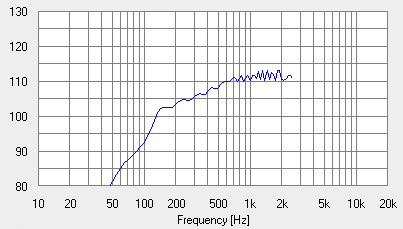
Found the specs, Heres how my version of your horn looks.
|
Posted By: Rog
Date Posted: 28 September 2004 at 10:24am
|
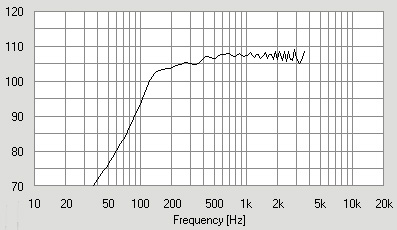
Hi Ray, The above plot is using your specs taken from Hornresp. I've done some modifications and have come up with this. Horn lenght 0.8 meters mouth 66 x 66 cm throat 350 sqcm rear chamber 15 liters front chamber 0.5 liters here is the lot and the expansion details.
Dist sqcm width angle 0.000 350.00 5.30 10.56 |
Posted By: Timber_MG
Date Posted: 28 September 2004 at 11:13am
|
*runs off to see how to get hold of AJ horn* Rog, is GedLee's SPEAK any good taht you know of? Other recommendations for Horn-modeling software not listed in your FAQ? |
Posted By: Rog
Date Posted: 28 September 2004 at 1:40pm
|
Hi martin, sorry for the late reply, I have been so busy these days. I've not used Ged Lees SPEAK, but I will try it now. I like AJ horn, for mid top its great and its predictions are good. So what you see is what it sounds like. Hornresp is good for bass, but I'm not convinced for mid or top horns. I also use Akabak with my own models of horns and chambers. This is the best way I have found yet. And no, I' can't send anyone the scrpits. Rog. |
Posted By: Timber_MG
Date Posted: 28 September 2004 at 2:08pm
|
@ Rog: Thanks, I appreciate the time. Akabak *drool* is a "little"
pricey ... methinks AJHorn would be a good value then. The results
differ so greatly from hornresp it seems at high frequencies that there
is little point to do a mid-horn design with it. @ Ray: Your diaphragm mass was given as 5 grams and hence you got the insane HF bandwidth . A sim with the T/S of Thielesmall.com differs significantly from Rog's AJHorn plot none the less. |
Posted By: RayVaughn
Date Posted: 28 September 2004 at 3:30pm
That's the mass of the diaphragm on the manufacturers website. The cones a polymer graphite material. I assumed this is one of the reasons why the drivers are £300 each... http://www.pioneer.co.uk/uk/product_detail.jsp?product_id=1474&taxonomy_id=43-203 - http://www.pioneer.co.uk/uk/product_detail.jsp?product_id=14 74&taxonomy_id=43-203 ------------- --------------- Ray Vaughn and on www.innerfield.co.uk www.rocketfestival.com |
Posted By: RayVaughn
Date Posted: 28 September 2004 at 3:39pm
Thanks for this. Very helpful. I'll get AJ horn too and have a play. ------------- --------------- Ray Vaughn and on www.innerfield.co.uk www.rocketfestival.com |
Posted By: Timber_MG
Date Posted: 28 September 2004 at 3:58pm
|
A normal A4 sheet is 80grams per squre meter. That means that a 530
square centimetre cone would weigh in at 4.3 grams. The moving mass
includes things such as a voice coil and partly the suspension elements
in addition to the cone weight. I'd go with the weight of 53 grams
(which is fairly light). Their compression drivers are even more "reasonably" priced  but sound absolutely beutiful. but sound absolutely beutiful. |
Posted By: RayVaughn
Date Posted: 28 September 2004 at 4:21pm
Where are you getting the 53g from? The thielesmall.com doesn't seem to list a mms or mmd ------------- --------------- Ray Vaughn and on www.innerfield.co.uk www.rocketfestival.com |
Posted By: Timber_MG
Date Posted: 28 September 2004 at 5:33pm
| I entered the other values into hornresp's wizards. WinISD comes up with a Mms of 59.5g |
Posted By: roborg
Date Posted: 28 September 2004 at 5:36pm
|
If you're gonna play with an MT102 sized cab the aj-horn demo is fairly useful, as it seems to be restricted to a 0.5m horn length, which is pretty much spot on for that cab (PS. model half the cab....) The optimum rear chamber volumes from horn-resp & aj-horn seem to tie in pretty accurately for me, good software all around.
cheers, Rob ------------- What I cannot create, I do not understand |
Posted By: Rog
Date Posted: 28 September 2004 at 5:49pm
|
Funny, I can model 30 meter horns using my AJ horn. What version have you got. |
Posted By: Timber_MG
Date Posted: 28 September 2004 at 5:51pm
That's mean.
|
Posted By: Rog
Date Posted: 28 September 2004 at 6:06pm
|
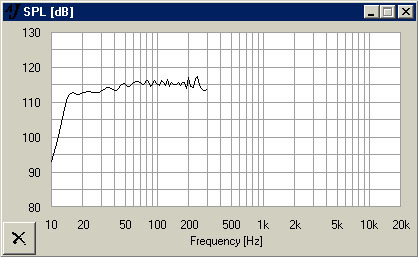
This is meaner. Anyone fancy an 11 meter horn with a Void V18 driver in it.
|
Posted By: Dom
Date Posted: 28 September 2004 at 6:25pm
I'll go warm up the table saw.... Sort the plans out... |
Posted By: roborg
Date Posted: 28 September 2004 at 8:32pm
I'm trying the free demo version off their site It's got a few restrictions in it
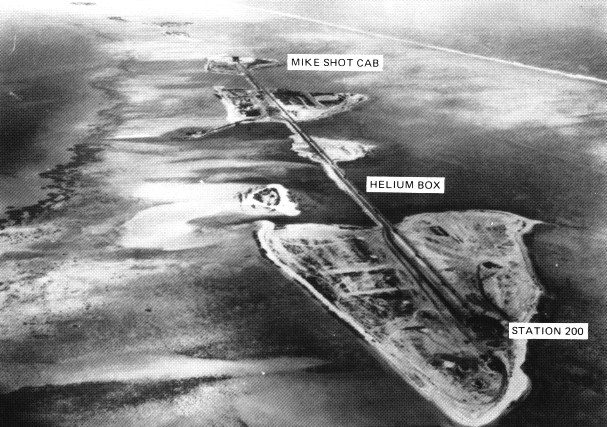
Now a 30meter horn is something! Makes me think of the plywood tunnel used in the first h-bomb test, 9000ft long with a h-bomb as the driver Alot of noise for a short time....
cheers, Rob ------------- What I cannot create, I do not understand |