Piezo tweeters?
Printed From: Speakerplans.com
Category: Other Chat
Forum Name: Roots n Culture Forum
Forum Description: Talk about speaker box with other sounds here
URL: https://forum.speakerplans.com/forum_posts.asp?TID=69915
Printed Date: 26 March 2026 at 7:09pm
Software Version: Web Wiz Forums 12.08 - https://www.webwizforums.com
Topic: Piezo tweeters?
Posted By: guitarplayerjoe
Subject: Piezo tweeters?
Date Posted: 16 August 2012 at 5:02pm
|
Hey guys, I've just been building a top-box for a four-way system. Anyway I was planning to load them with APT-80s but after looking at a load of established reggae sound-systems (unless I'm mistaken) they all look to have piezos in them. I'm not really sure what the crack is after seeing a load of posts slating them so I thought I'd ask you guys on the Roots and Culture Forum for your opinions on them. If you guys recommend using piezos then I'll probably buy a few of them instead and save a bit of money to go towards some nice outboard equipment.  Thank you!
|
Replies:
Posted By: Chris LDN
Date Posted: 16 August 2012 at 5:07pm
| Piezos are cheap. They have a certain sound (some say “ear splitting”, others say “crispy”). It's a tradition. Some people don't like change. |
Posted By: studio45
Date Posted: 16 August 2012 at 5:21pm
|
Modern cheap piezos are for jokers. Seriously. They have a very uneven frequency response, distort a lot, and have very low sensitivity - hence why you always see about nine million in one box. Using them below 7kHz is impossible unless you really hate your ears. Old Motorola/CDC piezos, on the other hand, are a different beast altogether, in a different kettle of fish. Though the sensitivity is still quite low, the response is much more even and distortion vastly lower. Additionally,they have inbuilt protection circuits that keep them going long after a £2.99 Maplin special would have expired in a sad little puff of smoke. They are hard to find these days so you would have to spend quite a lot of time searching them out. You will be paying between £10 and £25 each if you find them. Personally, I would never advise the use of piezos in modern times because 1" compression drivers such as the Fane CD130 have become very cheap and offer much better performance in all areas. You can get a pair of the drivers for about £40 and a pair of small plastic horns, eg 18Sound XT120, for another £15. There are a few other compression drivers around the same price point, but obviously avoid the Soundlab, Skytec, IMG Stageline brands as they are not on the same level as Fane in general. You would also need a highpass filter board, costing about £15 in components. I can PM you details of a suitable circuit that includes power shaping to bring up the very top end of the response and make it sparkle like people wish their piezos could ;) ------------- Studio45 - Repairs & Building Commotion Soundsystem -Mobile PA |
Posted By: Jahlive
Date Posted: 16 August 2012 at 5:47pm
| Piezos are poo compression drivers or apt but no piezos poor mans tweeters |
Posted By: Jahlive
Date Posted: 16 August 2012 at 5:48pm
They should be called poozo 
|
Posted By: guitarplayerjoe
Date Posted: 16 August 2012 at 6:07pm
|
Well if I chose piezo's I was gonna cross them as high as I could get, but thanks for your responses guys I shall keep well away from the "poozos"! Regarding the compression driver, I've already cut out circular holes to fit the APT's so I'm pretty happy to use them. I do have one question though, if piezo's are so terrible, why do so many systems use them? Or are they the Motorola ones?
|
Posted By: Chris LDN
Date Posted: 16 August 2012 at 6:14pm
|
 guitarplayerjoe wrote:
Posted By: Sheggy
Date Posted: 16 August 2012 at 6:44pm
|
Piezo's have there place - they are no all rubbish. First Motorola piezos were good. S |
Posted By: Dub Specialist
Date Posted: 16 August 2012 at 11:40pm
|
Roots boys seem's to set them up and got the nack to make them sound good cant remember the Roots Soundsystem name now of my head few months ago i went to and didnt sound too bad at all...and yeah +1 on the original moto's are ok and still usable..crossed quite high will take that low harshness out of them..........
------------- treat all creation with respect. For music is sound...sound is vibration...vibration is energy... and energy begets life. Therein lies my passion! MUSIC IS LIFE 
|
Posted By: TONY.A.S.S.
Date Posted: 17 August 2012 at 12:05am
|
I have heard a few systems with piezos that didn't sound too bad. They were probably crossed high. I would bring them in at above 10k over a CD just to add a bit of sparkle. Having said that, of course, if you did the same thing to better tweeters than piezos, your system would sound even better. ------------- http://www.facebook.com/tony.rossell.3" rel="nofollow - http://www.facebook.com/tony.rossell.3 |
Posted By: championdrei
Date Posted: 04 May 2013 at 9:25am
|
the original piezos that were being made in the 80s and early 90s were good got 8 of them and they sound crystal clear no distortion but nowadays they sound terrible ------------- respect |
Posted By: slaz
Date Posted: 04 May 2013 at 9:59am
Slight thread hi-jack if you don't mind folks - re the Moto piezos ..... I need something for my boombox. Piezos have one very useful attribute in this context ... light weight. Need tweeters to go above 2 x very good 8" Beyma bass-mid drivers (well an OEM 4 ohm version) .... sensitivity of the 8"ers is quoted as 96dB (which I think is conservative, as they sound gutsy even with tiny 15W x 2 amplifier). Now due to physical size/shape constraints I thought well lets try a couple of very cheapo piezos with just a 40R resisitor (as they could me made to physically fit OK) ..... and surprise surprise- they're pathetic. I have just "bass and treble" controls on the diddy amp - and if "flat" you can't hear any HF to speak of - if I use fair bit of "treble boost" you can hear em, but then there's horrible boost in upper mid - disgusting. They can be made acceptable-ish by using the 7-band EQ I have, but that compromises portability too much. Oh yeah - the 8" drivers claim to go substantially up to around 6k-7k. So .... wondering if the moto piezos might be a good choice here ? Are they dramatically more sensitive than the ultra-cheap shite ones ? They're not really cheap enough to casually toss aside if no good ..... If worth a try - should I go about getting/making something more than just a resistor to crossover - and what ? Can a regular Xover be used (2nd order mebbe ?) to define the Xover point ? TIA ... ------------- REMEMBER....POLITICIANS AND DIAPERS SHOULD BE CHANGED OFTEN AND FOR THE SAME REASON |
Posted By: studio45
Date Posted: 04 May 2013 at 11:59am
|
Not much more sensitive. I made a crazy thing last year to take to festivals; I wanted to have the lightest weight and highest output mid-top possible using what was "to hand" in the workshop. This ended up being based around an old Toa factory announcement re-entrant horn. I used Motorola piezos for tweeter duties as I had a bunch of them on the shelf recently removed from a client's old boxes. I started off with two. This was not enough so I added two more. Half an hour later I had ten of the buggers wired up. The system was still not balanced so I then started power shaping the horn (put a midrange cut filter and l-pad on it). Eventually I achieved a good balance and with some use of bitumen damping sheet managed to make the horn sound not like a tannoy horn. But yeah, it took ten Motorolas to keep up, so plan on using at least 4 per 8" unless you want to pad down the 8 and waste some power.
------------- Studio45 - Repairs & Building Commotion Soundsystem -Mobile PA |
Posted By: Dub Specialist
Date Posted: 04 May 2013 at 12:24pm
|
want to throw this up too regarding piezos ect got quite a few from over the years just keep them still done a lot of testing myself of piezos (all original KSN 1005 & KSN cts 1165 Powerline) not the cheap copys now that thay sell just out of interest and still find them intriguing to how people set theres up ect, and i have to say i seen nuff sounds using them still today so if peizos act like capacitance & impedance changes drastically with frequency so ive read ect im far far any expert in this just to say, but will you get any frequency shift using a passive x/o? you shouldnt as there is no impedance? so ive tested of my head think the box had 18/20 1005 piezos in it using a 5kHz 18db/oct high pass and thay sounded very sweat indeed has anyone got any idea/opinions that there is any problems in using it like this? many thanks ------------- treat all creation with respect. For music is sound...sound is vibration...vibration is energy... and energy begets life. Therein lies my passion! MUSIC IS LIFE
|
Posted By: studio45
Date Posted: 04 May 2013 at 2:40pm
|
The impedance of a capacitor decreases with increasing frequency. The larger the value, the faster the impedance falls. Piezos are small value capacitors. At some point up in the near-radio frequencies (way above 20kHz) the impedance will have fallen to a very small value, near zero ohms or an AC short circuit. This can cause some amps to go nuts, oscillate and blow themselves up, and some amps to produce a harsh sound because of instability caused by the impedance dip affecting reproduction in the audio band. However, the impedance can be thought of as a relatively constant high value - 1000's of ohms - in the audio band. Thus paralleling up many piezos, still doesn't bring the impedance down to normal coil speaker values.
The output of the piezo is proportional to the voltage across it and they pass only a very small amount of current. So if you put an 8 ohm power resistor across (in parallel with) your piezo bank, the whole bank will then effectively be an 8 ohm resistive load. The resistor will be dissipating most of the power, but the piezos will respond to the voltage across it. Depending on how many piezos are being used, it might need to be quite a big resistor, like 50 watts. Finally, to guard against possible 100kHz+ oscillation because of the impedance dip, put a 20 ohm power resistor in series with the piezos after the 8 ohm parallel resistor. This resistor will not dissipate much power, so can be a bit smaller, like 10 watts.
(in+)----------(20R)------(piezo bank +) | (8R) | (in-)-----------------------(piezo bank -) You can then feed this from a standard 5kHz 8 ohm crossover board, and the piezos will only see 5kHz+. If you just hook them up without the resistors, the crossover filters will not be terminated properly and will let lower frequencies through. ------------- Studio45 - Repairs & Building Commotion Soundsystem -Mobile PA |
Posted By: Dub Specialist
Date Posted: 04 May 2013 at 3:10pm
|
Thanks for the Indepth Knowledge/repley Very Intersting ive noticed that to with the boxes iv accumulated for repair/given over the years that there were a power resister across the terminal like 10r/27r 3/10w but like you say according to how many piezos wired in parallel the values were higher ect thanks ... ------------- treat all creation with respect. For music is sound...sound is vibration...vibration is energy... and energy begets life. Therein lies my passion! MUSIC IS LIFE
|
Posted By: RealitySound
Date Posted: 04 May 2013 at 11:58pm
How would you get piezos to play above a 2 inch comp horn? For instance the horn will play up to 18 k, and the piezos 18k +? thanks.. ------------- When you gonna send me some $$ mate ? |
Posted By: studio45
Date Posted: 05 May 2013 at 12:41pm
|
No a piezo won't play 18kHz+, the response has dropped off by then. 7k-18k is where they work best. There is usually a large spike in the response at around 16k which is responsible for their "sparkly" sound, but don't get confused about what frequencies are what.
Also what 2" horn have you got that plays up to 18k? Must be a really nice one to get that high, probably sounds fine on its own ------------- Studio45 - Repairs & Building Commotion Soundsystem -Mobile PA |
Posted By: RealitySound
Date Posted: 05 May 2013 at 1:52pm
|
Using this horn- http://www.parts-express.com/pe/showdetl.cfm?partnumber=294-808 loaded with- http://www.parts-express.com/pe/showdetl.cfm?partnumber=294-615 piezos- http://www.parts-express.com/pe/showdetl.cfm?partnumber=292-442 ------------- When you gonna send me some $$ mate ? |
Posted By: studio45
Date Posted: 06 May 2013 at 12:06pm
|
Yeah, I reckon piezos are a bit of a waste of time if you have that horn and driver. I would say you need bullet tweeters to add anything meaningful to what the DE750 can already do. In fact if you just use a bit of EQ on the very top end, you should be able to get the same response as if you added extra tweeters.
------------- Studio45 - Repairs & Building Commotion Soundsystem -Mobile PA |
Posted By: RealitySound
Date Posted: 06 May 2013 at 1:29pm
|
Hmmm.........already have piezos,.......and holes already cut unfortunately. Must go ahead with this, just need to find a way to get 4 piezos to only play high freq's. Any help much appreciated. http://s150.photobucket.com/user/ob1bda/media/SMT215/IMG_0420_zpsc34845a0.jpg.html" rel="nofollow"> 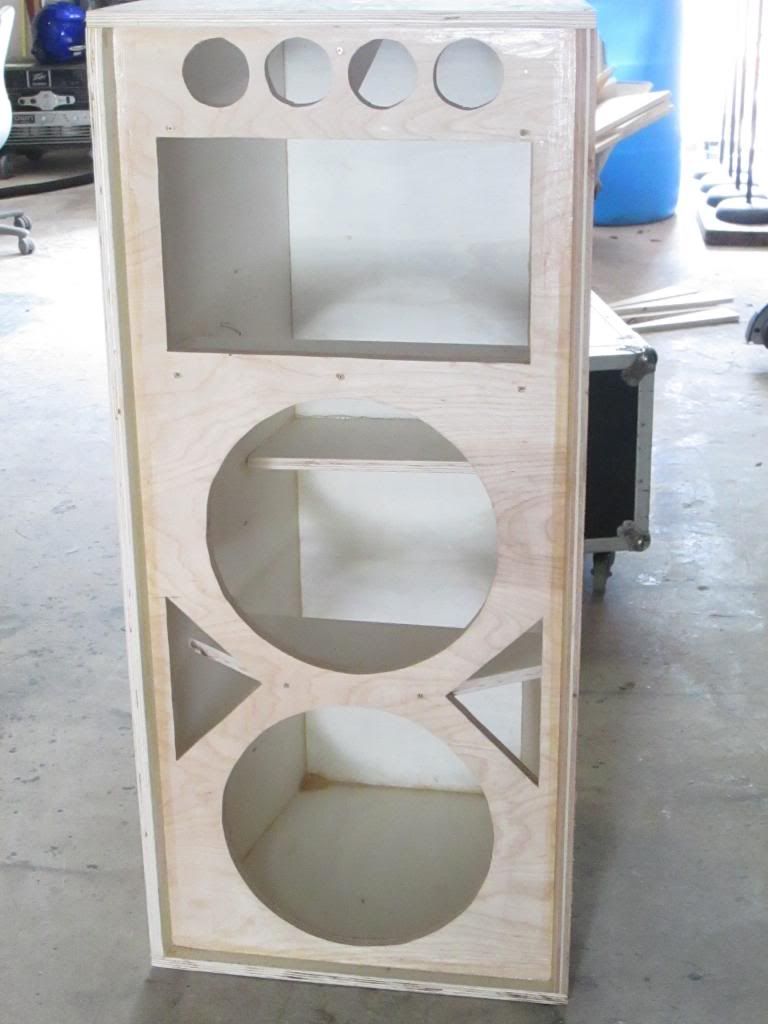 ------------- When you gonna send me some $$ mate ? |
Posted By: King Simeon
Date Posted: 06 May 2013 at 3:11pm
| A capacitor is a good idea, it will give a gradual slope, acting like a hi pass filter. Try different values, from 1 up to 4.7 and listen to the balance when playing with the horn. |
Posted By: studio45
Date Posted: 07 May 2013 at 12:43pm
|
Well, you could use the circuit I posted above, with the 8 ohm and 20 ohm resistors, but use a 10KHz highpass filter instead of a 5k. Four piezos will still not make a dent in the VHF response of that system, the horn will be much louder on its own. To make the horn balance with the piezos you will need to pad it down loads, and thus waste loads of power. Piezos are very quiet, that horn is very loud, it's not a good match. You could always block up those holes you know. And I can show you how to build a passive crossover that EQ's up the very top end of the horn....
------------- Studio45 - Repairs & Building Commotion Soundsystem -Mobile PA |
Posted By: RealitySound
Date Posted: 07 May 2013 at 12:48pm
|
I have some small B&C tweeters, going to see if they fit..... ------------- When you gonna send me some $$ mate ? |
Posted By: joshuamonger
Date Posted: 31 January 2024 at 2:21pm
| I am working on a project and I have found this post to be the most helpful on the internet as far as how to properly wire these things. I just have a couple questions maybe you can help or maybe not. Normally with no parallel resistor, the piezo ignores the crossover and I had to put a 2-ohm resistor in series to quiet it down a bit. Works fine but still the piezo is a bit too harsh. So I decide I want to add the parallel resistor and I really don't know what resistance to choose is the first issue. These speakers are rated at 4-ohm and the woofer is, there is also two horns that are vintage and are 45-ohm (22.5 in parallel) which isn't really my main concern at the moment. And then the piezo's which apparently does not matter if they are parallel or not since their impedance is something crazy high like 5k. The first question is, would i not want to do the piezo's at 4ohm? wouldn't that with the woofer drop the rating to 2ohm? Also have to consider when I run the pair of cabinets, would that not drop to 1ohm? I have a hard time understanding when the ohm's drop. I totally understand how parallel wiring works, so if the tweeters are parallel to the woofer it should drop again right? and two cabinets into an amp would be parallel again??? That I have trouble understanding. I am actually running these two musician speaker cabinets on a higher powered home amp (left and right channels currently) but in the future will have my PA system rated at 2ohm back. So the question is, would it not be better to choose 8ohm or 16ohm for the piezo bank? Then finally this last question is rather important. Normally the piezo's without resistor over-power the speaker. but with the shunting parallel resistor (and crossover removed for testing) they are just slightly too quiet. What can be done anything? Could i change the 8ohm resistor in parallel to a different one in order to get more voltage to the piezo's? and in regard to balancing the impedance of the speaker as a whole? I know this is an old thread, but any help is appreciated. Seems like you are the only one that understands how to properly wire these things. Thank you |