Booty Bass Build
Printed From: Speakerplans.com
Category: Plans
Forum Name: New Projects Forum
Forum Description: Forum for new speakerplans projects, in memory of Tony Wilkes, 1953 - 2014
URL: https://forum.speakerplans.com/forum_posts.asp?TID=79915
Printed Date: 26 March 2026 at 11:31pm
Software Version: Web Wiz Forums 12.08 - https://www.webwizforums.com
Topic: Booty Bass Build
Posted By: ash pegs
Subject: Booty Bass Build
Date Posted: 23 June 2013 at 5:25pm
|
Alright guys first of all this is MY FIRST EVER BUILD so please be nice! I am making Davey T's booty bass cab but slightly modified to make it smaller - I'm actually planning on using this in a car. Here's Davey's original thread: http://forum.speakerplans.com/davey-ts-215-bootybass-with-plans_topic27642.html" rel="nofollow - http://forum.speakerplans.com/davey-ts-215-bootybass-with-plans_topic27642.html I've reduced the width of the cab from 90cm to 88cm and the height has been reduced from 60cm to 46.6cm, so obviously the Vb is now much lower than Davey intended. I'm planning on mounting the drivers magnet-out to help with this. I have borrowed a pair of PD156 which I'm hoping will work in this cab. Here's my modified plan http://s490.photobucket.com/user/ashfancourt/media/IMG-20130621-WA0004.jpg.html" rel="nofollow"> 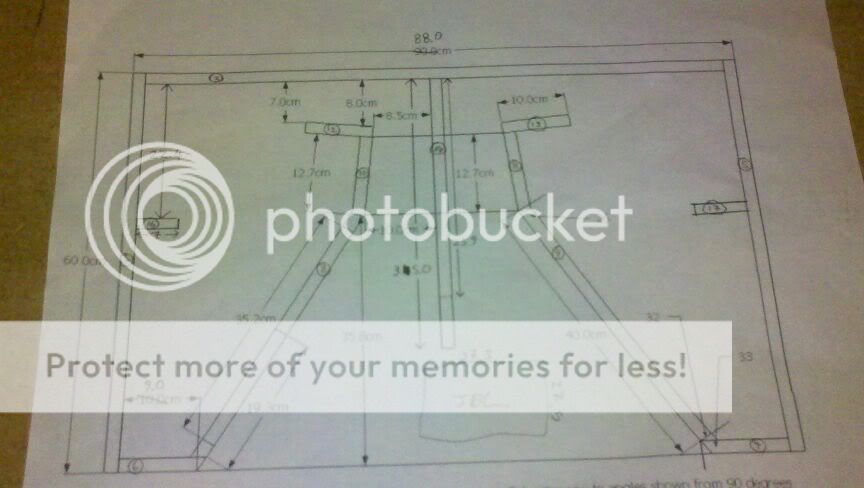 and here are some pics of my build so far http://s490.photobucket.com/user/ashfancourt/media/2013-06-14_12-34-15_817.jpg.html" rel="nofollow">  yes I'm using mdf! http://s490.photobucket.com/user/ashfancourt/media/2013-06-17_18-22-08_601.jpg.html" rel="nofollow">  the above piece I cut the wrong size for both the right and left so I had to cut two more pieces the correct size http://s490.photobucket.com/user/ashfancourt/media/2013-06-18_19-04-39_743.jpg.html" rel="nofollow"> 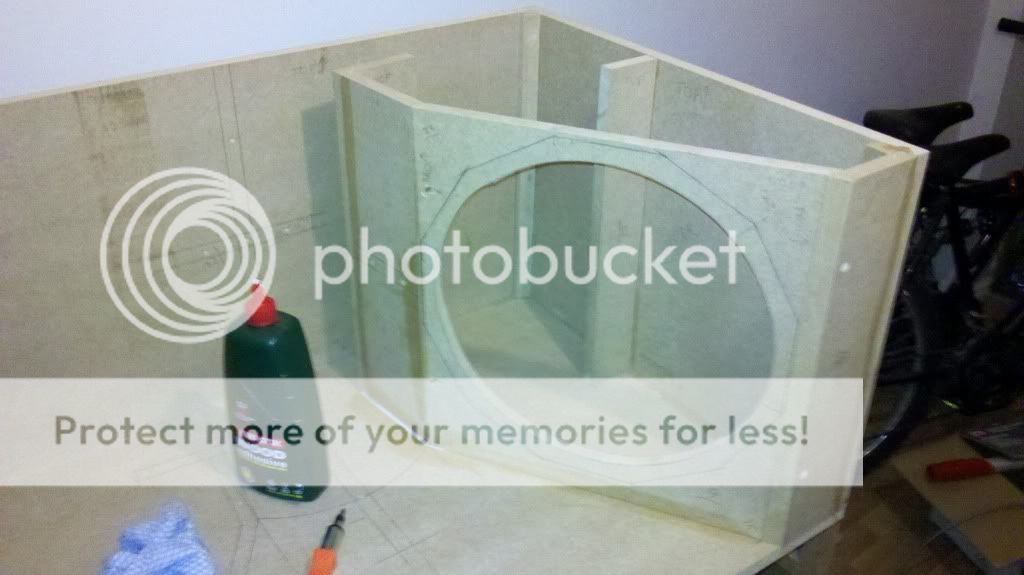 http://s490.photobucket.com/user/ashfancourt/media/IMG-20130621-WA0002.jpg.html" rel="nofollow"> 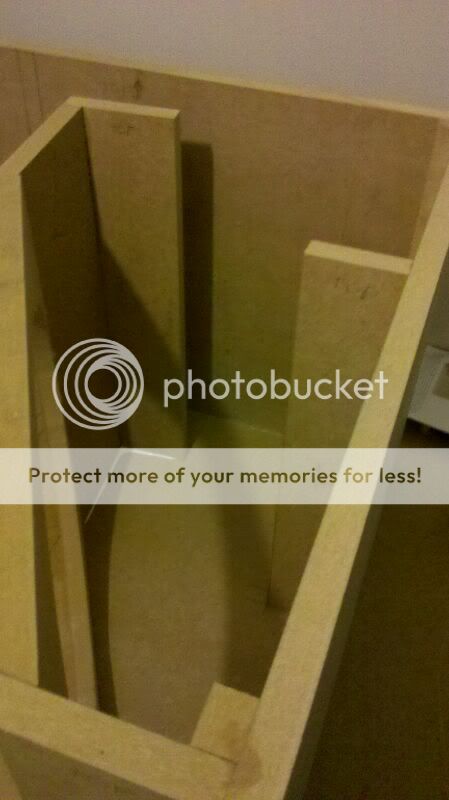 of course I am also adding several bits of bracing that are not on the original plans http://s490.photobucket.com/user/ashfancourt/media/2013-06-20_22-22-03_533.jpg.html" rel="nofollow"> 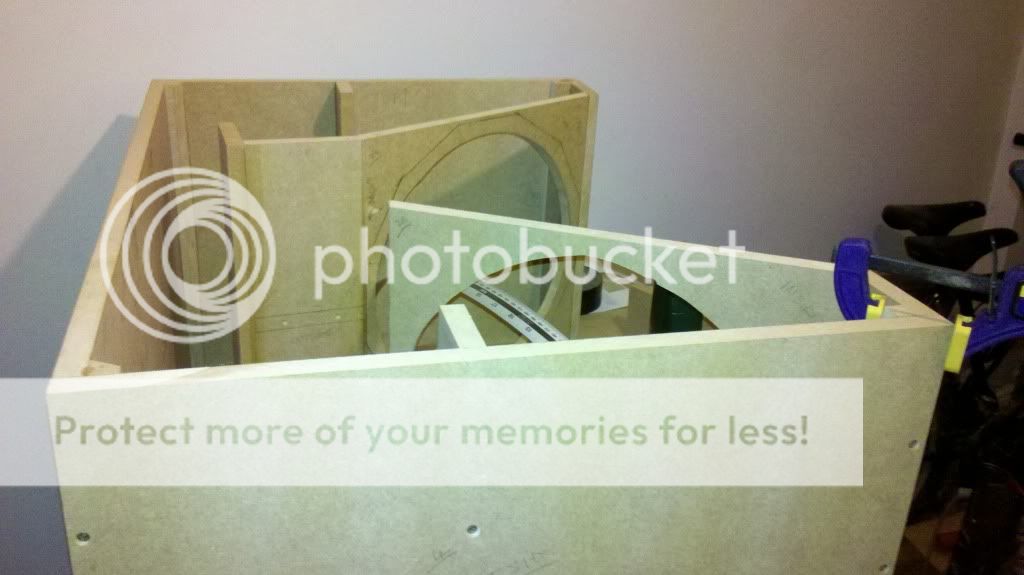 http://s490.photobucket.com/user/ashfancourt/media/2013-06-20_22-23-36_759.jpg.html" rel="nofollow"> 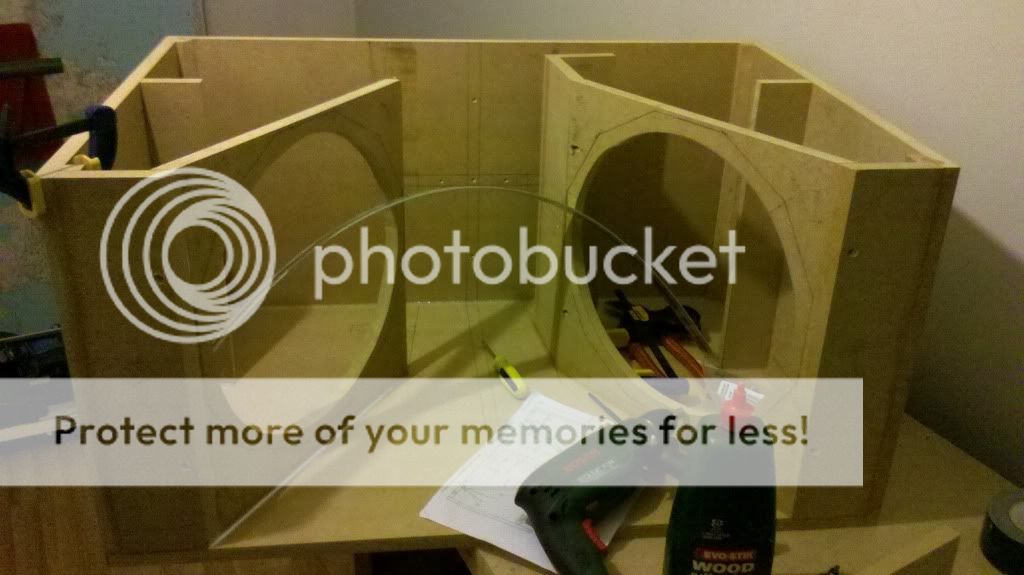 Will add some more for you as I get more done any comments welcome! Ash ------------- don't forget the cables |
Replies:
Posted By: Edd Jordan
Date Posted: 26 June 2013 at 3:55pm
looking good!  ------------- I do a sideline in ply wood wheels. |
Posted By: ash pegs
Date Posted: 14 July 2013 at 10:53pm
Got all my bits of wood together and I'm quite happy so far! http://s490.photobucket.com/user/ashfancourt/media/2013-07-08_20-39-50_17.jpg.html" rel="nofollow"> Both sides done and centre in place http://s490.photobucket.com/user/ashfancourt/media/2013-07-08_21-40-05_51.jpg.html" rel="nofollow">  I made the cross braces from one of the baffle cutouts, using the same curve http://s490.photobucket.com/user/ashfancourt/media/2013-07-08_21-40-23_163.jpg.html" rel="nofollow">  http://s490.photobucket.com/user/ashfancourt/media/2013-07-14_15-57-03_375.jpg.html" rel="nofollow">  Decided one handle per side would be enough as I'm not intending on lugging it about too often http://s490.photobucket.com/user/ashfancourt/media/2013-07-14_16-54-00_125.jpg.html" rel="nofollow"> 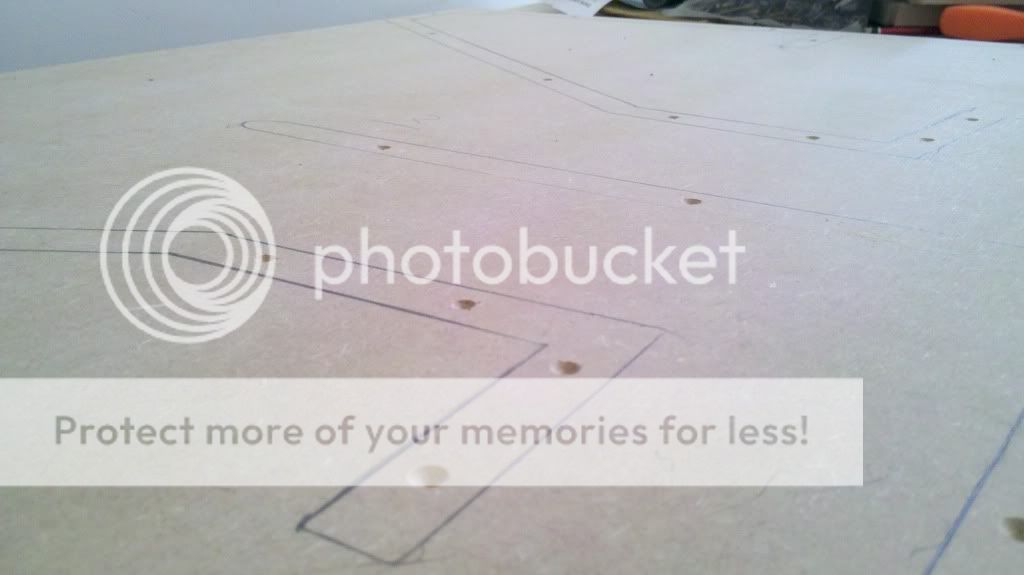 Got the top piece marked out and countersunk http://s490.photobucket.com/user/ashfancourt/media/2013-07-14_18-22-22_112.jpg.html" rel="nofollow"> 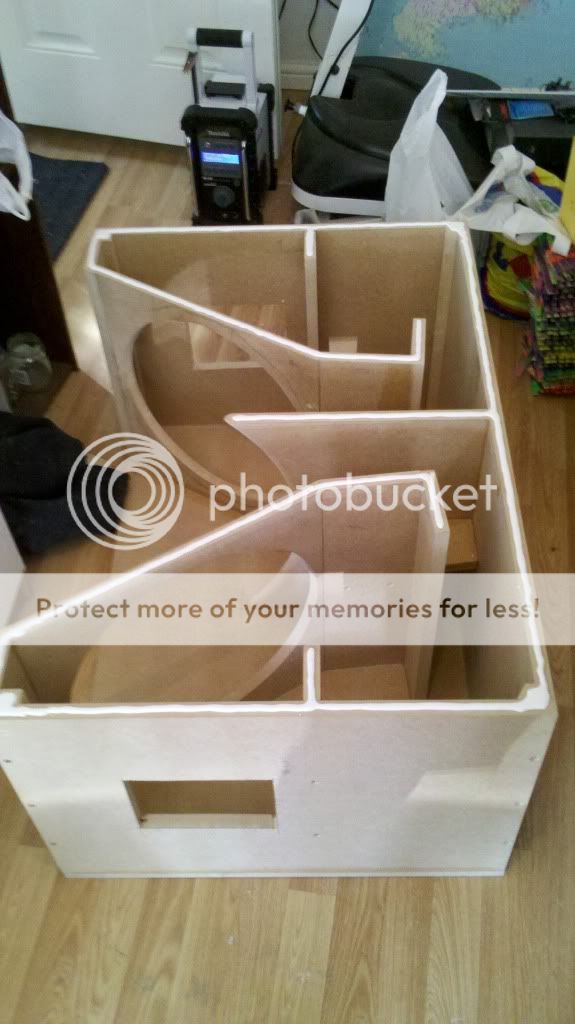 Glue time! http://s490.photobucket.com/user/ashfancourt/media/2013-07-14_18-22-50_559.jpg.html" rel="nofollow">  http://s490.photobucket.com/user/ashfancourt/media/2013-07-14_21-55-00_304.jpg.html" rel="nofollow">  Lid finally attached http://s490.photobucket.com/user/ashfancourt/media/2013-07-14_21-55-56_294.jpg.html" rel="nofollow">  Could somebody please let me know whether this type on cab will benefit from wadding? Thanks ------------- don't forget the cables |
Posted By: lycantheleopard
Date Posted: 15 July 2013 at 4:48am
| i dont know the plan well but if you have made it smaller, you would do well to put a good bit of wodding in the cab to trick the driver into seeing a larger vb. |
Posted By: TONY.A.S.S.
Date Posted: 15 July 2013 at 8:10am
|
That looks a very neat job. One thing I would say about the bracing though, MDF had very little Integral Strength, so although acoustically you can get away with the material for the main build, Plywood bracing would be more solid. ------------- http://www.facebook.com/tony.rossell.3" rel="nofollow - http://www.facebook.com/tony.rossell.3 |
Posted By: odc04r
Date Posted: 15 July 2013 at 9:57am
|
For a first build especially, very tidy. Great job. |
Posted By: Timebomb
Date Posted: 15 July 2013 at 12:37pm
|
Looks good, i think the PD156 should work well in this cabinet. ------------- James Secker facebook.com/soundgearuk James@soundgear.co.uk www.soundgear.co.uk |
Posted By: ash pegs
Date Posted: 15 July 2013 at 12:39pm
|
Thanks guys! I have taken my time to try and get everything right first time. The single most useful bit of kit I bought for this job has been my 1m metal ruler, you can't take too many measurements! I'll put some wadding in then but I'll keep it away from the port though so it doesn't do any funny business. I'll bear that in mind for anything I make in the future Tony, thanks for the tip. Next jobs are filling the countersinks, then sanding and painting Cheers Ash ------------- don't forget the cables |
Posted By: Steve_B
Date Posted: 15 July 2013 at 2:11pm
Just a little nit picking; MDF obviously has some integral
strength or it would fall apart when you tried to move it. It is also a pretty
safe bet that some materials have greater strength than MDF and others have less
strength. Saying that a material has very little strength is meaningless
without quoting some figures. I might be moaned at for going on about this, but at some
point in the future someone who has read this thread will repeat the fact that
MDF has very little strength, then someone else will, and so on. Soon it
becomes accepted wisdom that MDF has very little strength. But what does very
little strength mean or imply? MDF might have less strength than plywood, but unless you
know what the actual strength of the material is, and what loads the material
is subject to the comparison between the two is irrelevant. The MDF’s strength
might be more than adequate. You also need to know how the load is acting on the body. 4mm
steel wire is probably stronger than a 25 cm broom handle, as long as the load
is in tension. The broom handles would make better legs for a table where the
load is under compression. At this point, to avoid seeming hypocritical, I should
sprinkle a few figures about. Unfortunately I haven’t got time. |
 TONY.A.S.S. wrote:
Posted By: TONY.A.S.S.
Date Posted: 15 July 2013 at 3:40pm
|
Steve, I don't need sets of figures to know that if I hit a box made from 18mm MDF with a club hammer, a hole will appear sooner than if it was 18mm ply. I always look at braces to support panels, but they have to be rigid and an 18mm ply brace will be more rigid because of its makeup than MDF. In the context of this subject, what else do we need to know?
------------- http://www.facebook.com/tony.rossell.3" rel="nofollow - http://www.facebook.com/tony.rossell.3 |
Posted By: mobiele eenheid
Date Posted: 15 July 2013 at 4:44pm
|
Well, the Young modulus would be a start. Around 4 for quality MDF, around 6 - 7 for Baltic Birch perpendicular to the grain and around 8 - 10 along side the grain (all GPa slash N/mm2). You could also look up the tension or compression modulus.
Btw higher number is better in this case.
|
Posted By: ash pegs
Date Posted: 15 July 2013 at 8:47pm
|
OK I think it's obvious that ply would be better than MDF for use in bracing (trees have been growing tall and strong for a long time so they must know what they're doing right?) but I don't have any ply and I do have a load of MDF so for THIS particular project everything will be of the fibreboard ilk. When it comes to proper cabinet bracing I don't think anyone has more knowledge than Tony (just look at any A.S.S. cab) and what he's saying certainly makes sense to me. Before I venture into another build I will be getting hold of a router and some plywood to go with my favourite long metal ruler. But I haven't finished this one yet, so I'm going downstairs to do some filling. ------------- don't forget the cables |
Posted By: mini-mad
Date Posted: 15 July 2013 at 11:52pm
|
.... slight tangent... i love my metal meter rule too. wouldnt give it up for the world. as the rule goes.. "measure 3,578 times, cut once... slowly... and as strate as possible"  ------------- If it sounds like a gorilla is trying to escape, turn it down. |
Posted By: ash pegs
Date Posted: 16 July 2013 at 6:47am
^ this  ------------- don't forget the cables |
Posted By: Steve_B
Date Posted: 16 July 2013 at 12:25pm
|
When building loudspeaker cabinet you don’t really need to
know very much at all. If you did, very few people would be building
loudspeakers. As a comparison, how many people build their own amplifiers?
Being successful at making a living from selling loudspeakers has more to do
with having a good business plan than knowledge of acoustics and materials. So, If the internal bracing needs to be ply, why not the
speaker baffles or the other panels? It is not as though the structure is like
a steel framed building where the walls just stop the wind blowing through and
people falling out. The whole box acts as the structure. Hitting a material with a hammer simply tells you how it
reacts to being hit with a hammer. The point I was trying to make is the fact
one material is not quite as strong as another doesn’t by default make it
unsuitable. If the loads it can sustain are greater than the loads imposed on
it, then it will be fine. Johan gives us a figure for Young’s modulus, but doesn’t
give any values (4 what???) It is only about 4.2 to the nearest star but I
wouldn’t like to walk. No explanation regarding the implication of Young’s
modulus is given either, except that bigger is better. On that basis we should
perhaps be using aluminium which has a value of 69 or even better stinging
nettle fibres with a value of 87. The units for the values given are GPa or gigapascals or if
you prefer KN/mm2. The imperial value for MDF is 580,000 lbft/in2.
So is 580,000 beefy enough? Young’s modulus for those that didn’t do physics tells us
how elastic a material is. It is the ratio of stress to strain. Rubber can have values as low as 0.01 GPa,
yet if you hit it with a hammer it probably won’t be damaged but the resultant
bounce of the hammer might damage your head. Young’s modulus tells us how much
a material will stretch before it breaks. Johan is correct in that less
stretchy is better, but like in all engineering problems, the question is how
unstretchy is sufficient? If we need to know what load will break the material we
could try the tensile strength. According to the MDF manual, it has a tensile
strength of 0.7 N/mm2 or 0.7MPa.
So how does this compare with other materials? Concrete has a value of 3MPa,
Glass fibres have a value of 3500, carbon fibres 6300. 0.7 doesn’t seem a lot which would tend to confirm that it
is not a good material to use. So given its common use in loudspeaker cabinets
why don’t we see more falling to bits? First tensile strength just tells us the strength when the
material is in tension. If the load is compressive then the value is different.
I couldn’t find a value for MDF but concrete which has a tensile strength of
3MPa can have a compressive strength of up to 40MPa. Also the cabinet is a compound structure. A box or tube is
able to withstand bending loads far better than a simple piece of material with
an equivalent cross section. Going back to simple, and using the figures above, we can
consider an experiment. The brace in the cabinet looks about 260mm in length
and is I presume 18mm thick. That gives us a cross sectional area of 4680mm2.
If we suspend this and hang a load off the bottom, it should be able to support
4680 x 0.7 = 3276N. For those not familiar with Newtons it is the equivalent to
334 Kg force. So the brace should be able to support the full weight of the
cabinet. Given that GPa is a unit of pressure and we are discussing
loudspeakers we can look at the actual pressures of the sound. 0dB our reference
level is 2 x 10⁻⁵Pa while 130dB is 63Pa. Note that these are Pa and
the values for materials above were MPa or
Pa x 106. As I stated previously just coming on and stating that ply
bracing is better than mdf is likely to lead down the slope to where at some
point in the future, because it has been repeated so many times, that you can’t
use mdf for internal bracing. Look how many people think that you need 4 bass
horns for them to work properly without understanding that it is actually the
combined mouth area that matters not the number of horns. note that values are published averages. Any individual example of a material might differ from these values. |
Posted By: Tony Wilkes
Date Posted: 16 July 2013 at 12:39pm
|
I have always used plywood braces on plywood boxes purely because that just happens to be the material that I am working with at that moment. I would have absolutely no worries at all about using MDF bracings in a ply box if it was the only material available. Most HQ Hi-Fi boxes using MDF also use MDF for bracings. To me it is a Non-issue, lots more things to worry about :) Tony ------------- www.forteaudio.eu - BMS - db-Mark Processors - Lexon (SAE) |
Posted By: Timebomb
Date Posted: 16 July 2013 at 1:50pm
|
Surely (acoustically) it is more important how a material resonates than how it performs under compression and tension. Plywood is stiffer, but so is steel and it rings and resonates far more than MDF. I always thought MDF reduced resonance as it is made up out of small cross directional fibres rather than long grains like plywood, so pressure waves were less inclined to travel down it as they are broken up, i could be wrong though. Ive heard the same argument made about fiberglass. I bult a test cab from OSB once and thought it sounded better than ply. I dont think ive ever read a proper explanation of why MDF is preferable for speaker cabinets, other than it is is less resonant, but why? ------------- James Secker facebook.com/soundgearuk James@soundgear.co.uk www.soundgear.co.uk |
Posted By: Tony Wilkes
Date Posted: 16 July 2013 at 2:01pm
|
MDF = Self damping and greater mass + easy to get a good machined surface + better quality stock is very consistent ------------- www.forteaudio.eu - BMS - db-Mark Processors - Lexon (SAE) |
Posted By: mini-mad
Date Posted: 16 July 2013 at 2:03pm
|
wow!... you lot really will argue about anything wont you? LOL ..give it up and admire the OP's effort and wood working skillz! cant wait to see it fully finished... let us know how she plays ------------- If it sounds like a gorilla is trying to escape, turn it down. |
Posted By: Timebomb
Date Posted: 16 July 2013 at 2:04pm
|
Also if a brace is extremely stiff wont it transfer vibration to an apposing panel, rather than absorb or dampen, or be less susceptible to resonance in the first place? Is there is always a trade off of stiffness and resonance and low loss of energy vs absorbancy los of power. ------------- James Secker facebook.com/soundgearuk James@soundgear.co.uk www.soundgear.co.uk |
Posted By: Tony Wilkes
Date Posted: 16 July 2013 at 2:07pm
I like to see them more as "technical discussions", good way for newbies to learn. Tony ------------- www.forteaudio.eu - BMS - db-Mark Processors - Lexon (SAE) |
Posted By: Timebomb
Date Posted: 16 July 2013 at 2:08pm
|
Yeah sorry for the hijack ash pegs, i think its an interesting question though, might start another thread. ------------- James Secker facebook.com/soundgearuk James@soundgear.co.uk www.soundgear.co.uk |
Posted By: TONY.A.S.S.
Date Posted: 16 July 2013 at 6:27pm
|
My only comments were that Ply would be more solid, am I wrong, but hey what do I know? ------------- http://www.facebook.com/tony.rossell.3" rel="nofollow - http://www.facebook.com/tony.rossell.3 |
Posted By: colint
Date Posted: 16 July 2013 at 7:57pm
Sod all by the look's of thing's, I mean it's not like you've built many cabs is it  ------------- Never criticise another man until you've walked a mile in his shoes. Once you have, call him what you like, you're a mile away and you've got his shoes! |
Posted By: Dub Specialist
Date Posted: 17 July 2013 at 12:17am
|
make the braces out of Spider Webs , come on boys you know its one if not the strongest thing's know to man concrete cabs spider web bracing now theres someting different ------------- treat all creation with respect. For music is sound...sound is vibration...vibration is energy... and energy begets life. Therein lies my passion! MUSIC IS LIFE 
|
Posted By: Steve_B
Date Posted: 17 July 2013 at 10:44am
|
I don’t know what you know, as I said before, the ability to
successfully build and sell loudspeakers doesn’t require much knowledge about
the theory behind it. Maybe you know a lot maybe you don’t. I am just replying to what you wrote. The problem is, that by posting “One thing I would say about the bracing though, MDF had
very little Integral Strength, so although acoustically you can get away with
the material for the main build, Plywood bracing would be more solid.” it gives the impression (at least to me) that using MDF for the bracing is
inadequate. If that is the case my question is why is it inadequate. Either
explain theoretically or point to lots of examples of MDF braced cabinets that
have structurally failed.
As Tony W said this is more a technical discussion, or if
you prefer argument then it is a connected series of statements intended to
establish a proposition. Perhaps you are not bothered about how things work. I am; I
am curious sometimes rhetorically. The actual answer, although it might be
important, is less interesting than the how or why. The latter are more
important if you want to do something original. If you design or build something there should be a reason
behind every decision. They don’t always have to be technical. The OP used MDF
because as he said, that is what he had. Large manufacturers sometimes tend to
work round what packs well in trucks. Take for instance the use of Birch ply in the construction
of cabinets. It seems to be an accepted
assumption that it is the best material. But ask yourself why? Most, if honest,
should answer because everybody else uses it, or that is what brand X uses so
it must be the best. How many actually consider what properties make it a good
choice and explore whether those properties can be found in other materials. Not applicable in this thread, but if someone is unwilling
to explain why they believe what they say, or write, why should they expect me
to believe them? I know sometimes it is difficult to put things in words, but
most of what is discussed on this forum is not new so just a link or reference
to a paper or book would be useful. Trying to work everything out from first
principles every time would be pointless. The other problem of simply stating things is that they get
repeated and repeated, taken out of context and repeated and so on. After a
while, statements like the one above turn into the common knowledge that you
can’t use MDF for bracing cabinets because it has no strength.
The number of cabinets built is irrelevant to the
discussion. If I build a million cabinets with ply bracing and none fail, I can argue
that from empirical evidence that ply bracing is suitably strong. It would be
wrong to infer from the experience that MDF is not strong enough. |
Posted By: ash pegs
Date Posted: 17 July 2013 at 9:11pm
|
The way I was looking at it when I decided what bracing to put in and where, was that on the original plan there was no specified bracing, so when I decided to add corner bracing, side panel bracing, and centre cross-bracing, the more bracing I added the more solid the structure would become, regardless if what materials were honed from. As far as is practical, I think more bracing must be a good thing when it comes to acoustics. Of course Davey T did not need to include bracing in the plan, his job was to do the maths of the design, which by all accounts he has excelled in, it is then down to the builder (in this case me) to decide how much and what type of bracing to add, and like i've said the more the better IMO. I don't yet know if what I have decided on will be "right" or not, I will only know that after many hours of listening, but whatever the outcome I have enjoyed this build so far and I plan to enjoy it lots more when I get to pay some proper tunes through it. ------------- don't forget the cables |
Posted By: TONY.A.S.S.
Date Posted: 17 July 2013 at 9:13pm
|
The battle rages on, so just so there is no misunderstanding, these are my last comments on the subject. Regarding bracing. For a long time now I've been seeing cabs with contoured shapes looking very attractive, especially when painted in contrasting colours. This is a matter of taste of course, but I see a lot of Form over Function. I see thin braces most of the time. However I'm not here to dictate what should and should not happen. My view on MDF is that it is very good acoustically and I put that down to the material being reasonably dead by virtue of there being no grain for resonance transfer. All my HI FI cabs are made from MDF, but I wouldn't be confident in them unless the panels were at least 50mm thick and were supported by braces which had a tee section to them. My largest cab is a struggle for two people to lift, however we get away with that because of what it is and where it ends up. This is what's on my mind when I refer to integral strength. Take a piece of 18mm thick MDF and 50mm wide, around 400mm long and snap it over your knee, it will break, and then try to do the same with ply. When you next put a thin MDF support in your box, run the cab up and put your hand on the brace, check whether you can feel any vibration. I have never seen the point of using supports that may be weaker than the panel. As in all things there will always be qualifications. If your MDF brace only had to span say 100mm and it was 50mm thick, I would say it's a great brace and probably does its job. Back to what seems to have turned into an interesting discussion only if to indicate how different people see things. Ply is stronger than MDF like for like, that is what I believe. Being responsible for thousands of cabs in the past has no bearing on what I have learnt, that's a production thing. It's the development and experiments with sound that have given me what ever it is I know and allowed me into the market place with numerous designs that have sold because people like them. I've seen many technical quotes on here over time which have come straight out of the books I have, but my GA Briggs book taught me the most, because it's the book I connected with. This certainly has turned into a Hijack for which I apologize. Anyway People, as you were. ------------- http://www.facebook.com/tony.rossell.3" rel="nofollow - http://www.facebook.com/tony.rossell.3 |
Posted By: ash pegs
Date Posted: 18 July 2013 at 11:14am
|
I don't mind - keeps my thread bumped! ------------- don't forget the cables |
Posted By: ash pegs
Date Posted: 13 October 2013 at 9:37pm
|
Hi guys! Finished this build a little while ago now so thought I'd post up some more pics for those that were following it I first tried filling some of the countersinks with some polyfilla stuff out of a tube but found that this didn't set hard enough, so I removed it and got some two part car body filler (as per the build guide on here) and was very happy with the result. First time I've used this sort of filler, it's serious black magic chemical type stuff! This picture shows some of the original filler that I didn't end up using http://s490.photobucket.com/user/ashfancourt/media/2013-07-20_12-24-30_402.jpg.html" rel="nofollow">  I have cut and fitted an extension piece in the centre of the lower edge of the mouth as this is where I'll be mounting the amp http://s490.photobucket.com/user/ashfancourt/media/2013-08-24_16-40-03_228.jpg.html" rel="nofollow"> 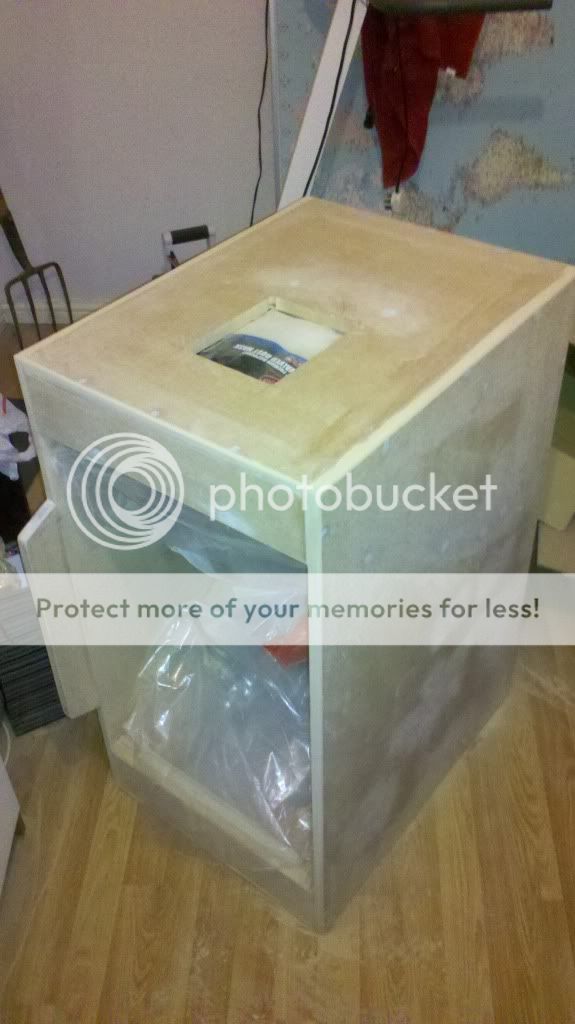 I stapled in some wadding, then realised that I should have done this after I had finished all the sanding, so I covered the baffle holes and filled the ports with plastic before sanding down all of the filler and the rest of the cab. As I don't yet own a router I rounded over the edges using an orbital sander. I did get a good result with this technique but I don't think I would have tried it if I was using ply. http://s490.photobucket.com/user/ashfancourt/media/2013-09-14_10-14-43_533.jpg.html" rel="nofollow">  Above pic is after the first coat, which I applied with a small foam roller. I used some black Ronseal paint meant for external woodwork and not requiring a primer. http://s490.photobucket.com/user/ashfancourt/media/2013-09-14_10-13-38_273.jpg.html" rel="nofollow">  Did three coats in all, with the top one dabbed on with a sponge to get the texture I wanted. http://s490.photobucket.com/user/ashfancourt/media/IMG-20130918-WA0008.jpg.html" rel="nofollow">  The amp is now mounted in the bottom of the mouth and I've put the handles in and added some metal corners http://s490.photobucket.com/user/ashfancourt/media/2013-09-18_22-31-15_46.jpg.html" rel="nofollow">  and loaded with the outstanding PD156 suddenly the mouth looks very crowded http://s490.photobucket.com/user/ashfancourt/media/2013-09-18_23-06-40_160.jpg.html" rel="nofollow">  The amp is a JBL bp1200.1 capable of 1200wrms @ 2ohms. With the 156s in parallel 600wrms would be available if I really wanted it http://s490.photobucket.com/user/ashfancourt/media/2013-10-09_17-14-31_417.jpg.html" rel="nofollow">  On the scales the unloaded cab is 30kg or with drivers and amp 62kg So in conclusion... I enjoyed building this booty bass and have learnt a few things too so big thanks to Davey, Tony and all others who have chipped in along the way. In reality though this plays far too loud for listening to in the back of my car (I've removed the rear seats) so I run it on an nth of the power so that it doesn't hurt my ears. Am low passing it at 80hz as I've found any higher than that makes bits of my car try to jump ship. Any more comments gratefully received! Cheers Ash ------------- don't forget the cables |
Posted By: infrasound
Date Posted: 13 October 2013 at 10:27pm
|
"In reality though this plays far too loud " - Not surprised! Nice build. How much LF extension are you getting?
|
Posted By: ash pegs
Date Posted: 20 October 2013 at 2:28pm
|
I asked my girlfriend this question and she said "er, ten? Although I could probably come up with a better answer than that i'm not sure how to test this accurately. I could download some sine waves of various frequencies and see how low I can take it? ------------- don't forget the cables |
Posted By: snowflake
Date Posted: 22 October 2013 at 11:05am
|
interesting article here: http://www.resfreq.com/usefulinfoonwood.html" rel="nofollow - http://www.resfreq.com/usefulinfoonwood.html making composite panels from mdf and ply might not be too time consuming. and if you do it cleverly could eliminate some of the router work on rebating the edges.
|
Posted By: thepersonunknown
Date Posted: 23 October 2013 at 10:28am
|
I have been thinking bout doing that for a while, too much of a pain though as of yet. Edit: thought I should eplain myself a little better... Remember u can't have any of the mdf showing at all, as if u do it will inevitably get scratched/bumped and wet. I've already had to directly bin cabs because of this and its very anoing. To do it well you need to not only cover the top, bottom, sides and ends with ply, but also run ply round the edges of the fronts. Your then left with a dilema that if you want to rout any handles or other details into it, u reveal the mdf below, therefore u are forced to either do more silly little ply skirting round each exposed edge or use fixings everywhere. Ok its not such a big deal, but it is basicly the same as building te cab twice (inner skin, outer skin) with perfect precision cos just the slightese inaccuracy will leave u with voids between panels, and then spend a long time fiddling round covering up all the bits of mdf which inevitably still stick out round the front, or the edge of any hole uve routed. It was enough to put me off for now, still, I wold love to see someone do it, and I might well myself one day if I'm felling flash for time. ------------- They keep telling me life is short, but its the longest thing ive ever done!!! |