ceramic resistor query
Printed From: Speakerplans.com
Category: General
Forum Name: Feedback Forum
Forum Description: How Your Projects Perform
URL: https://forum.speakerplans.com/forum_posts.asp?TID=91065
Printed Date: 27 March 2026 at 12:38am
Software Version: Web Wiz Forums 12.08 - https://www.webwizforums.com
Topic: ceramic resistor query
Posted By: Tweeter_Box
Subject: ceramic resistor query
Date Posted: 09 March 2015 at 6:01pm
|
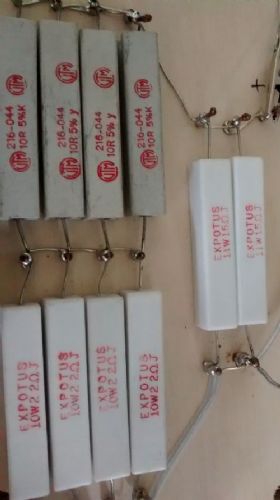
1. Am i correct in assuming the value of one of the resistors in the top of the pic is 10r 5w? 2. Can i replace a 11w resister with the same ohm 10w ?? Wat difference will the 1w make? Many thanks ------------- https://www.facebook.com/PurpleAudioRecords |
Replies:
Posted By: markie
Date Posted: 09 March 2015 at 6:05pm
|
There's no pic. ------------- If it's got wheels or tits it's gonna cost a fortune |
Posted By: Tweeter_Box
Date Posted: 09 March 2015 at 6:16pm
|
Hmm not uploading from my fone so gettin on laptop inna min ------------- https://www.facebook.com/PurpleAudioRecords |
Posted By: Tweeter_Box
Date Posted: 09 March 2015 at 9:17pm
------------- https://www.facebook.com/PurpleAudioRecords |
Posted By: Tweeter_Box
Date Posted: 09 March 2015 at 9:17pm
|
thats better! ------------- https://www.facebook.com/PurpleAudioRecords |
Posted By: Nachural
Date Posted: 09 March 2015 at 9:32pm
|
Looks like a 10 ohm resistor of 5% tolerance. Likely to be a 10w resistor, generally the longer the resistor the higher the wattage rating but if in doubt just fit a 12w or 15w unit assuming they fit in the space. Edit- This should do the trick, though hunt around a bit because they can be had for a lot less:- http://www.amazon.co.uk/RESISTOR-11W-10R-Resistors-Fixed/dp/B00SYDCXO6/ref=sr_1_30?ie=UTF8&qid=1425937037&sr=8-30&keywords=resistor+10+ohm+11w" rel="nofollow - http://www.amazon.co.uk/RESISTOR-11W-10R-Resistors-Fixed/dp/B00SYDCXO6/ref=sr_1_30?ie=UTF8&qid=1425937037&sr=8-30&keywords=resistor+10+ohm+11w (wire shown bent over but straightens out to make an axial unit)
------------- it's all just cardboard and magnets really |
Posted By: Tweeter_Box
Date Posted: 09 March 2015 at 9:57pm
|
cheers for that, so whats the difference between a 10w & 11w what difference would it make if i swapped one for another assuming the other values stayed the same? ------------- https://www.facebook.com/PurpleAudioRecords |
Posted By: kedwardsleisure
Date Posted: 09 March 2015 at 11:00pm
|
I wouldn't have thought it mattered much. A 10W western-made resistor is probably better than a chinese 11W resistor, chinese vs british watts etc ------------- Kevin North Staffordshire |
Posted By: mini-mad
Date Posted: 09 March 2015 at 11:17pm
I may steal that as my tagline.... ------------- If it sounds like a gorilla is trying to escape, turn it down. |
 chinese watts vs. British watts
Posted By: Earplug
Date Posted: 10 March 2015 at 10:27am
How common are 11W resistors? I´ve seen plenty of 5-10-15-20W, etc. I don´t see the point. If 10W is too small, just go to 15W. There really isn´t that much difference in the size.  ------------- Earplugs Are For Wimps! |
Posted By: Nachural
Date Posted: 10 March 2015 at 6:17pm
|
11w is a very unusual rating and as Kevin says a British or European 10w unit would no doubt be fine. ------------- it's all just cardboard and magnets really |
Posted By: Tweeter_Box
Date Posted: 11 March 2015 at 12:48pm
|
what does the 10W actually do in a resistor? ------------- https://www.facebook.com/PurpleAudioRecords |
Posted By: DMorison
Date Posted: 11 March 2015 at 1:10pm
Tells you how much power it can dissipate. Not to be confused with the power rating of the product it's used in, as that depends on the overall circuit design. David.
|
Posted By: studio45
Date Posted: 11 March 2015 at 1:49pm
|
It's worth noting that wirewound power resistors are some of the most indestructible components; being simply a coil of nichrome wire on a heatproof stick in a ceramic casing, they "work" (ie provide the right resistance) right up until the point the wire melts, so even if they're glowing red-hot they can still be functional. I've seen units where the ceramic casing has burnt/fallen away leaving just a charred coil and former, but it still has continuity, and measures about the right number of ohms. EG the soft-start resistors in power amps are usually 25 or 50 watt units, but have to withstand a surge of several hundred watts during the start-up process; this over-rating is not a problem, and they survive many cycles. So, basically, 1 watt of difference between an original and replacement part is no difference at all. ------------- Studio45 - Repairs & Building Commotion Soundsystem -Mobile PA |
Posted By: Tweeter_Box
Date Posted: 11 March 2015 at 2:20pm
Cheers guys, perfect explanations  ------------- https://www.facebook.com/PurpleAudioRecords |
Posted By: Nachural
Date Posted: 11 March 2015 at 3:53pm
I recently came across some passive crossovers where the ceramic resistor had survived but were glued to a plywood base which had charred badly. No wonder the customer could smell burning from the ports after a gig.  ------------- it's all just cardboard and magnets really |
Posted By: kedwardsleisure
Date Posted: 11 March 2015 at 4:39pm
|
Sound-to-Smoke feature ------------- Kevin North Staffordshire |
Posted By: njw
Date Posted: 11 March 2015 at 6:40pm
|
This is what happened when the resistor in the soft start circuit of one of my C-Audios decided it had had enough; 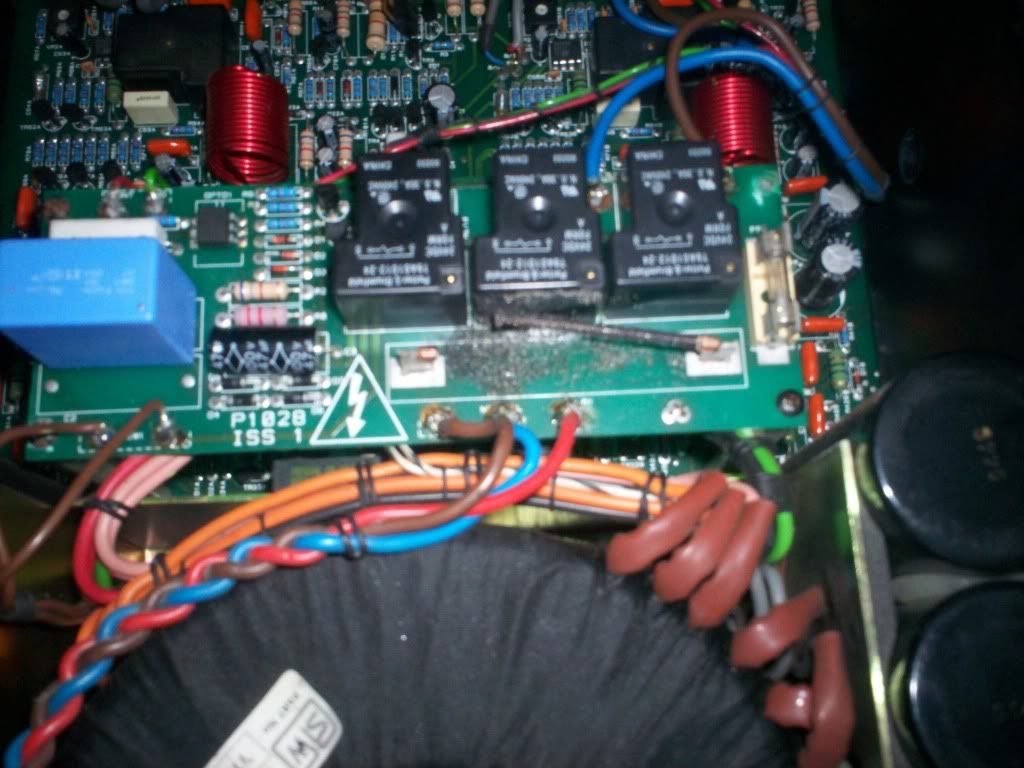 The rest of it was rattling around inside! 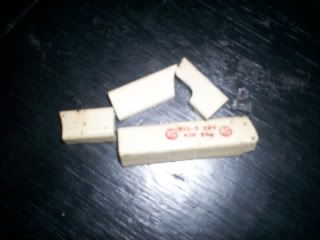 |
Posted By: Tweeter_Box
Date Posted: 11 March 2015 at 6:52pm
Ouch  ------------- https://www.facebook.com/PurpleAudioRecords |
Posted By: Tweeter_Box
Date Posted: 11 March 2015 at 11:59pm
So in a passive crossover board replacing a 10w 10r with a 20w 10r would actually be better as theres less chance of it failing? And wouldnt alter the attenuation levels at all? ------------- https://www.facebook.com/PurpleAudioRecords |
Posted By: mini-mad
Date Posted: 12 March 2015 at 12:13am
|
Correct. 20w is just its power handling. Iv got a box of 10,15 and 20w wire wounds somewhere.... if it says 10w use that as your 'minimum requirement' rating. ------------- If it sounds like a gorilla is trying to escape, turn it down. |
Posted By: Tweeter_Box
Date Posted: 12 March 2015 at 7:10am
Cheers for clearin that up mini  ------------- https://www.facebook.com/PurpleAudioRecords |
Posted By: _djk_
Date Posted: 13 March 2015 at 7:45am
|
Be aware that those ceramic resistors will have a temperature rise of 250°C over ambient at their rated power.
Derated to 40% of rated power they will only be slightly warmer than boiling water!
Also keep in mind that solder melts around 180°C. ------------- djk |
Posted By: stevie
Date Posted: 13 March 2015 at 5:53pm
|
Resistors are responsible for more faults in speaker crossovers than any other component. For the few pence that it costs, over-specify the resistors, and space them off the board. |
Posted By: mini-mad
Date Posted: 13 March 2015 at 6:34pm
or buy 'heatsinked' wire wounds....  ------------- If it sounds like a gorilla is trying to escape, turn it down. |
Posted By: stevie
Date Posted: 13 March 2015 at 7:59pm
|
Yes, they're great - except they're not fully heatsinked as they are. You need to add a proper heatsink to achieve the quoted power handling. |
Posted By: mini-mad
Date Posted: 13 March 2015 at 8:10pm
|
Just bolt them to an L Bracket and screw said bracket to the inside of the cab! Jobs a goujon! ------------- If it sounds like a gorilla is trying to escape, turn it down. |
Posted By: Tweeter_Box
Date Posted: 13 March 2015 at 10:25pm
|
Cheers guys Wanna upload some pics of progress so far but files are bigger than the limit ------------- https://www.facebook.com/PurpleAudioRecords |
Posted By: mini-mad
Date Posted: 13 March 2015 at 10:56pm
Chuck them in windows paint and shrink/resize to 40% of original size, then drag in the borders til its a 6inch square on ya screen... resave file under different name then upload with a foot print less then 25% of original file size. Just remember to save it as a jpeg and your good to go! ------------- If it sounds like a gorilla is trying to escape, turn it down. |
Posted By: chickenfizz
Date Posted: 24 March 2015 at 12:34am
Absolutely, this can be a problem in high power passive crossovers. I've seen a number of incidents of resistors becoming unsoldered or very badly oxidised solder joints, easily melting hotglue or cable tie mounts (bad design). Best to spread the power over a number of over-rated resistors paralleled which allows the heat more surface area to dissipate from and remote them from the PCB onto a metal plate. Or better still, go active! Seems silly to deliver all of this power to the speaker only to deliberately waste it as heat. Orrr you could retain the passive crossover but without the pad, knowing that you'd have to EQ the box to stop the horn blowing your head off, but you buy yourself some amp headroom back and don't spend it on heating up a few resistors. Also, the resistance of a wirewound resistor will increase as it gets hot which will affect the volume of the HF and the crossover frequency, the voltage drop across it becomes greater, therefore the power dissipated by it increases too and the cycle goes on.
|
Posted By: snowflake
Date Posted: 24 March 2015 at 1:37pm
|
need to mount the resistors on a reasonably large heatsink to keep them temperature and resistance stable. I've got a few 10cm and 20cm sections of the 190AB and 193AB heatsinks from ABL if anyone is interested http://www.abl-heatsinks.co.uk/index.php?page=extrudedresults
|
Posted By: matty w
Date Posted: 08 May 2015 at 6:23am
|
I had a 10w resister burn out (brake ) on one of its tails just the other day .... Surely the fact that this component has already blown tells u it's a bad idea to replace with a less powerful one :D lol , Probably underspecced in the first place , 15 watt is the winner here ------------- Black to black , red to red , blue to bits .... |
Posted By: APW
Date Posted: 08 May 2015 at 3:03pm
If the leg has snapped off it’s more likely to be due to metal fatigue caused by repeated mechanical stress due to the vibration caused by the sound the speaker produces within the cab or exterior vibration caused by rough handling rather than being overpowered. Replacing with a higher powered resistor would not make any difference to the unit’s reliability and may in fact make the reliability worse due to a change in the mechanical resonance of the component; In this case a change only a change to the means of mounting the component would increase the reliability of the unit. |
Posted By: matty w
Date Posted: 08 May 2015 at 3:59pm
|
Thanks APW I appreciate the advice , my advice was for the op's post not my own situation , I replaced the resister in my crossover with the exact same component , The resister in my crossover blew when I was doing something stupid or experimenting shall we say , I tried wiring an additional resister in series with the midrange output on a 3 way crossover , then turned it up to maximum operating power to proof test if there would be any issues .... And there was lol , I literally watched the resister on the crossover (presumably part of an l pad on the mid output)glow and brake ! I was expecting a glow from the protection bulbs to indicate to me it was running at maximum , then I planned to back it off a little , however it wasn't the protection bulb that lit up , it was the resister :D A cheap thing to replace so no harm done and I learnt that wiring a resister in series with an output of a crossover that already has an lpad is a bad idea :D ... Nothing like getting involved Ay ------------- Black to black , red to red , blue to bits .... |