
|
ceramic resistor query |
Post Reply 
|
Page <123> |
| Author | |
DMorison 
Old Croc 
Joined: 14 March 2007 Location: Aberdeen Status: Offline Points: 1740 |
 Post Options Post Options
 Thanks(0) Thanks(0)
 Quote Reply Quote Reply
 Posted: 11 March 2015 at 1:10pm Posted: 11 March 2015 at 1:10pm |
Tells you how much power it can dissipate. Not to be confused with the power rating of the product it's used in, as that depends on the overall circuit design. David.
|
|
 |
|
|
studio45
Old Croc

Joined: 16 October 2007 Location: United Kingdom Status: Offline Points: 3881 |
Post Options
Thanks(0)
Quote Reply
Posted: 11 March 2015 at 1:49pm |
|
It's worth noting that wirewound power resistors are some of the most indestructible components; being simply a coil of nichrome wire on a heatproof stick in a ceramic casing, they "work" (ie provide the right resistance) right up until the point the wire melts, so even if they're glowing red-hot they can still be functional. I've seen units where the ceramic casing has burnt/fallen away leaving just a charred coil and former, but it still has continuity, and measures about the right number of ohms. EG the soft-start resistors in power amps are usually 25 or 50 watt units, but have to withstand a surge of several hundred watts during the start-up process; this over-rating is not a problem, and they survive many cycles.
So, basically, 1 watt of difference between an original and replacement part is no difference at all.
|
|
|
Studio45 - Repairs & Building Commotion Soundsystem -Mobile PA
|
|
|
|
|
Tweeter_Box
Young Croc 
Joined: 23 June 2012 Location: London Status: Offline Points: 859 |
Post Options
Thanks(0)
Quote Reply
Posted: 11 March 2015 at 2:20pm |
|
Cheers guys, perfect explanations

|
|
|
https://www.facebook.com/PurpleAudioRecords
|
|
|
|
|
Nachural
Young Croc

Joined: 15 April 2009 Location: West Midlands Status: Offline Points: 1259 |
Post Options
Thanks(0)
Quote Reply
Posted: 11 March 2015 at 3:53pm |
|
I recently came across some passive crossovers where the ceramic resistor had survived but were glued to a plywood base which had charred badly. No wonder the customer could smell burning from the ports after a gig.

|
|
|
it's all just cardboard and magnets really
|
|
|
|
|
kedwardsleisure
Old Croc
Joined: 20 January 2009 Location: Staffordshire Status: Offline Points: 5157 |
Post Options
Thanks(0)
Quote Reply
Posted: 11 March 2015 at 4:39pm |
|
Sound-to-Smoke feature
|
|
|
Kevin
North Staffordshire |
|
|
|
|
njw
Old Croc

Joined: 26 March 2010 Location: S. Wales Status: Offline Points: 2700 |
Post Options
Thanks(0)
Quote Reply
Posted: 11 March 2015 at 6:40pm |
|
This is what happened when the resistor in the soft start circuit of one of my C-Audios decided it had had enough; 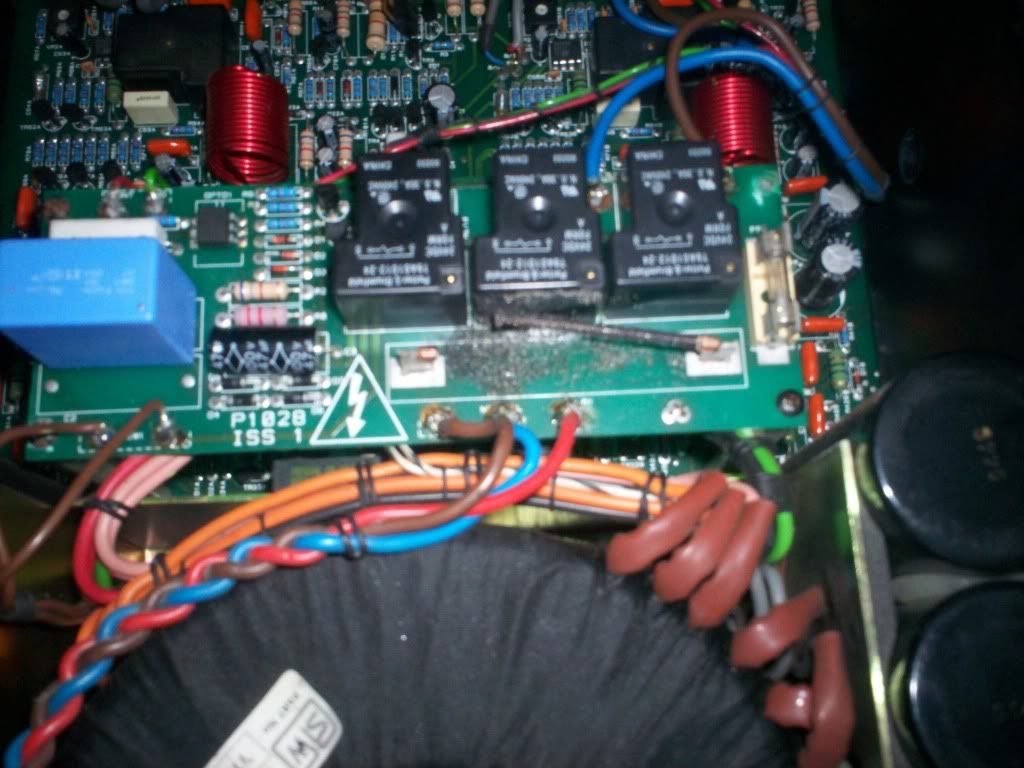 The rest of it was rattling around inside! 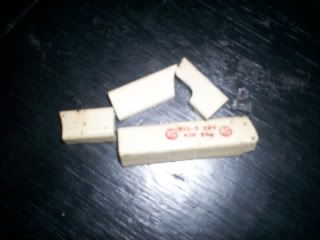 |
|
|
|
|
Tweeter_Box
Young Croc
Joined: 23 June 2012 Location: London Status: Offline Points: 859 |
Post Options
Thanks(0)
Quote Reply
Posted: 11 March 2015 at 6:52pm |
|
Ouch

|
|
|
https://www.facebook.com/PurpleAudioRecords
|
|
|
|
|
Tweeter_Box
Young Croc
Joined: 23 June 2012 Location: London Status: Offline Points: 859 |
Post Options
Thanks(0)
Quote Reply
Posted: 11 March 2015 at 11:59pm |
So in a passive crossover board replacing a 10w 10r with a 20w 10r would actually be better as theres less chance of it failing? And wouldnt alter the attenuation levels at all? |
|
|
https://www.facebook.com/PurpleAudioRecords
|
|
|
|
|
mini-mad
Old Croc

Joined: 13 July 2012 Location: london Status: Offline Points: 6861 |
Post Options
Thanks(0)
Quote Reply
Posted: 12 March 2015 at 12:13am |
|
Correct. 20w is just its power handling. Iv got a box of 10,15 and 20w wire wounds somewhere.... if it says 10w use that as your 'minimum requirement' rating.
|
|
|
If it sounds like a gorilla is trying to escape, turn it down.
|
|
|
|
|
Tweeter_Box
Young Croc
Joined: 23 June 2012 Location: London Status: Offline Points: 859 |
Post Options
Thanks(0)
Quote Reply
Posted: 12 March 2015 at 7:10am |
|
Cheers for clearin that up mini

|
|
|
https://www.facebook.com/PurpleAudioRecords
|
|
|
|
|
_djk_
Old Croc
Joined: 23 November 2004 Location: United States Status: Offline Points: 5992 |
Post Options
Thanks(0)
Quote Reply
Posted: 13 March 2015 at 7:45am |
|
Be aware that those ceramic resistors will have a temperature rise of 250°C over ambient at their rated power.
Derated to 40% of rated power they will only be slightly warmer than boiling water!
Also keep in mind that solder melts around 180°C.
|
|
|
djk
|
|
|
|
|
stevie
Registered User 
Joined: 16 March 2008 Location: Dorchester Status: Offline Points: 433 |
Post Options
Thanks(0)
Quote Reply
Posted: 13 March 2015 at 5:53pm |
|
Resistors are responsible for more faults in speaker crossovers than any other component. For the few pence that it costs, over-specify the resistors, and space them off the board.
|
|
|
|
|
Post Reply
|
Page <123> |
| Tweet |
| Forum Jump | Forum Permissions You cannot post new topics in this forum You cannot reply to topics in this forum You cannot delete your posts in this forum You cannot edit your posts in this forum You cannot create polls in this forum You cannot vote in polls in this forum |


 Topic Options
 Tweeter_Box wrote: