
|
Small,Light Sub? |
Post Reply 
|
Page <123> |
| Author | |||
mini-mad 
Old Croc 

Joined: 13 July 2012 Location: london Status: Offline Points: 6861 |
 Post Options Post Options
 Thanks(0) Thanks(0)
 Quote Reply Quote Reply
 Posted: 16 May 2015 at 6:40pm Posted: 16 May 2015 at 6:40pm |
||
|
please do... AND we do love a good build log on here. everyone seems to be giving up on them as of late so it would be nice to see you knock together a few boxes with some picture AND your thoughts on the 2 boxes side by side.
Cheers !! |
|||
|
If it sounds like a gorilla is trying to escape, turn it down.
|
|||
 |
|||
|
DMorison
Old Croc
Joined: 14 March 2007 Location: Aberdeen Status: Offline Points: 1740 |
Post Options
Thanks(0)
Quote Reply
Posted: 17 May 2015 at 2:08pm |
||
Well, if tuned to cover the same frequency range, the 15 will require almost exactly twice the box size, but will be very nearly as loud as two of the 12's (only one dB less, when driven to full excursion), so it comes down to a choice of fewer, bigger boxes vs more smaller ones to achieve a given output. Below are the output curves for one of each, sized and tuned to get -3dB at 40Hz, which takes 160l net internal for the 15 and 80l for the 12. (I've used the 8Ω versions as that's what I already had loaded in WinISD, from the pdf's you linked to they seem close enough to the 4Ω versions for the purposes of this comparison.) I suspect the 15 is rather less than twice the price of the 12 so that may be cheaper. However it would require an amp with higher output capability - 55V rather than 45V in the case of these box sizes/tunings (roughly equivalent to nominal power ratings of 375W @ 8Ω vs 250W @ 8Ω), so that may partially offset any cost savings from using the larger driver. So, you need to decide for yourself exactly where your priorities lie - if that weight target from your first post is rigid, I don't think you'll achieve that at all with the 15 unless you really compromise how deep you take it. That's because sacrificing LF extension allows you to use a smaller cabinet. On the other hand, if you need more output than a couple of the 12's can give, then you're doubling the total bulk of the rig by adding more boxes to make them keep up with fewer of the 15's anyway, and probably increasing cost as well. HTH, David.  |
|||
|
|||
|
rbarone
Registered User 

Joined: 12 March 2008 Location: United States Status: Offline Points: 45 |
Post Options
Thanks(0)
Quote Reply
Posted: 17 May 2015 at 2:56pm |
||
|
Thank you very much David for such a thorough & understandable reply.
That's a substantial difference... I expected more out of the 3015, but wouldn't have imagined x2. The cost to build 1 pair of either size is pretty close... The 3012 is $135 & the 3015 is $155 USD ..similarly, with power & lumber. I guess if the goal becomes realizing the output of the 3015 from 2 pair of 3012, all in the name of weight savings, then the 3015's become a good bargain. (half the build time, as well) If it was only performance-based, the 3015's are the ticket - I'll have to confer with the group to see where they'd prefer to compromise. Thanks Again - Rob |
|||
|
|||
|
amlu
Young Croc 

Joined: 30 November 2009 Location: london Status: Offline Points: 740 |
Post Options
Thanks(0)
Quote Reply
Posted: 17 May 2015 at 10:44pm |
||
|
i have kind of small light subs on my system. 500x500x500 boxes made from 15mm ply.
92liters each. front panels come off held with 12 bolts and insert nuts. 2x 12 inch beyma 12br70 and two used to be 10inch eminence but upgraded for 15 inch beyma sm115/n vents done from 40mm compression drain pipe fittings, can replace them with other lenghts if needed. used winISD for port dimensions. 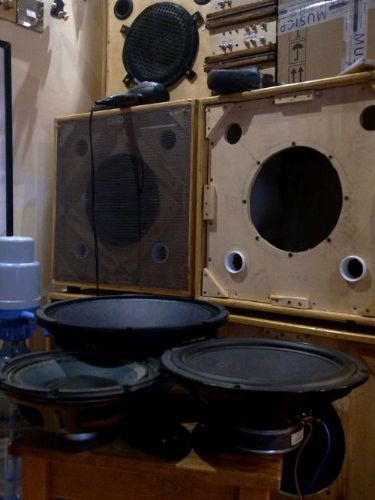 |
|||
|
|||
|
rbarone
Registered User
Joined: 12 March 2008 Location: United States Status: Offline Points: 45 |
Post Options
Thanks(0)
Quote Reply
Posted: 18 May 2015 at 2:30pm |
||
|
Amlu - Thanks.. that's about the size I'm looking to work with. What tops do you run with them? Do you use them to DJ or for a band - & how do you feel they perform? - Rob
|
|||
|
|||
|
amlu
Young Croc
Joined: 30 November 2009 Location: london Status: Offline Points: 740 |
Post Options
Thanks(0)
Quote Reply
Posted: 18 May 2015 at 6:15pm |
||
|
above got some 10 inch beymas for mids (simple reflex boxes too), got my old mid-tops (6.5+beyma cp22) but they may go for monitor duty, got some 1 inch compression drivers.... working to make some boxes for them recently. using for electronic music mainly. how they perform i cant compare much, too loud to test in my garden, and presumably loud enough when i take them out :-)
|
|||
|
|||
|
rbarone
Registered User
Joined: 12 March 2008 Location: United States Status: Offline Points: 45 |
Post Options
Thanks(0)
Quote Reply
Posted: 18 May 2015 at 7:23pm |
||
|
thanks amlu - I'm prepping a build now for 2 pair of tops, but hope to get on to this sub build soon afterward. I appreciate the input.
I'm leaning toward a Cubo12 & a simple ported cabinet, both with a Kappalite 3012LF4 - then an A/B comparison. My reservations come with the info provided by DMorison... seems a good 15 will double a 12. The trade-off, being bigger & heavier. Do you know the volume & porting spec's for the Beyma SM115 N? It's about 5# heavier than the 3015, but if I could bring the cabinet in around the mid 4's cu. ft. (I think that's 120 liter area), it may provide the best balance. Cheers - Rob
|
|||
|
|||
|
DMorison
Old Croc
Joined: 14 March 2007 Location: Aberdeen Status: Offline Points: 1740 |
Post Options
Thanks(0)
Quote Reply
Posted: 18 May 2015 at 10:23pm |
||
|
Hi again Rob,
If you’re willing to spend a little more on processing and power (and
accept a couple of other slight compromises), you can push the box size down a
bit for the 15, if that helps (technically you could do it with the 12s too,
but that doesn’t take away from the underlying relationship between the two in
terms of output). This relies on the fact that the driver is reaching its maximum linear excursion on rather less than the maximum power it can actually handle. So, that means there may be some headroom available (which you could “access” via a parametric EQ in a digital speaker processor combined with a larger amp) to boost what would otherwise be lower bass levels. This has to be done in conjunction with a high pass filter to prevent massive over-excursion if any lower frequencies are present however. Below are the Output, Excursion and Processor response curves for the 3015LF in a 110l (net) box, or approx. 3.9ft3 tuned to 41Hz. Because of the boost put in to flatten the response, this would need an amp capable of 76V output or 720W @ 8Ω nominal rating – over the continuous rating of the driver but less than the commonly accepted “program” rating that is often used for matching amplifiers to speakers. As the actual impedance is a little less than 8Ω right around the frequency where the boost is applied, this would translate to almost exactly 900W (= the program rating for this 8Ω version of the driver) being applied to the driver any time a full strength signal at that frequency came along in your music. Note the max SPL (below 100Hz) is just as high as the bigger version I posted above, and it still gets to 40Hz.
The actual processor setting used to achieve this would be: High Pass: 12dB Butterworth 45Hz Low Pass: 24dB Butterworth 100Hz (this one can pretty much be varied to
suit your tops without much effect on the driver at lower frequencies, so is
just an example for the time being) Parametric EQ: 40Hz +6.3dB, Q=3. Although 6dB (and change) of boost looks like a lot, the fact that the
high pass frequency overlaps it keeps the net result to a perfectly manageable amount. Allowing for decent sized vent and bracing etc, this could be built
into a total cabinet size of 500W x 600H x 580D (or 19.68” x 23.62” x 22.83”
for the metrically challenged HTH, David. |
|||
|
|||
|
rbarone
Registered User
Joined: 12 March 2008 Location: United States Status: Offline Points: 45 |
Post Options
Thanks(0)
Quote Reply
Posted: 18 May 2015 at 10:51pm |
||
|
Thanks Again David. Those are some creative numbers.
The band has a dbx driverack, so I guess that would serve, but that's a lot of juice for a 1x15... Let me ask you this - based on amlu's use of a Beyma SM115 N, I checked out the spec's & ran it through a basic enclosure calculator... it spit out a sealed box of 3.789 cu. ft. (107.29 Liters). My initial interest was in a sealed enclosure, because I was told they would be the easiest to EQ - they'd just need more power. Do you agree with that sentiment? Thanks, once again, & Enjoy the evening ...if you're in Aberdeen, Scotland it must be near 11. -Rob |
|||
|
|||
|
DMorison
Old Croc
Joined: 14 March 2007 Location: Aberdeen Status: Offline Points: 1740 |
Post Options
Thanks(0)
Quote Reply
Posted: 19 May 2015 at 1:46pm |
||
The DBX should have the capability to do the processing if you went down this route. The increased power is indeed one of the compromises I alluded to, yes, but it would normally be tempered by the fact that music (especially live stuff) tends to be very dynamic. That means ie the average level is much less than the peaks, due to the player's phrasing, gaps between notes etc, so unless you have unusually heavy bass for the type of band, you'd probably be fine.
The Beyma has less Xmax than the Eminence, so all else being equal, it will never put out as much bass. While different T/S paprameters affect how the driver interacts with the box to give its final frequency response, the bottom line for low frequency output (in a given cabinet type) is simply how much air it can shove around (think Caroll Shelby - "no replacement for displacement"). So, unless there's a very compelling reason (Cost/Availability/Weight etc) to use it, it would always be lower down my list of preferred drivers for your needs. On sealed vs vented cabs, I don't wholly disagree per se, however I do think that the description you were given is maybe a little oversimplified, therefore less useful than it might initially appear. If a driver has the right parameters to be flat to 40Hz in a sealed cab of a given size, then yes it will be less efficient than another driver with the right parameters to be flat to 40Hz in a vented cabinet of the same size. You would then need to hit the sealed box with more power to get it up to the same volume as the vented box. That's the part I can agree with easily enough. The flip side is that if you take the same driver and put it in both box types (of the same size), it will go lower in the vented box. However, they're both going to be limited by displacement, so the one that starts out more efficient could go on to be pushed harder and have a higher max volume if they had the same Xmax. The Sealed box will (almost certainly) have a more gradual roll off below 40Hz, so if you need to tweak its response with tricks like I illustrated above, that is potentially a little easier, and it will also have a lower "group delay". Group Delay (roughly) describes how the output is delayed (as a result of the various mechanisms that cause the frequency response to be anything other than flat) compared to the input of the system, so a box with higher group delay risks sounding less "fast" or "tight" in subjective terms. Tricks like using EQ to boost the response to sharpen up the corner at the low end of a small box do add to the group delay, so that is one of the other compromises I referred to before.
You're welcome. Yes, was pottering about playing with the modelling and composing the response while half-watching a bit of TV so it ended up being a tad late by the time it was done. Cheers, David. Edited by DMorison - 19 May 2015 at 1:47pm |
|||
|
|||
|
rbarone
Registered User
Joined: 12 March 2008 Location: United States Status: Offline Points: 45 |
Post Options
Thanks(1)
Quote Reply
Posted: 19 May 2015 at 6:15pm |
||
|
David - I certainly owe you a couple of pints for all the time & info...
Given all the facts you've provided, it's really hard to argue against a 15" sub. I suppose the task is to build the "best" of the lightest versions. If I could possibly trouble you further (because I really don't know how to interpret the data, with regard to performance), what is your opinion of the 3 models here? My speaker vendor quotes bassbox for optimum sizes for the 3015LF 4 - - a sealed cabinet of 2.2 cu. ft. / 62.3 liters with F3 of 80 Hz (about 400 mm cube) - a vented box of 3.3 cu. ft. / 93.45 liters with F3 of 52 Hz - but they do not provide any info about the porting. (about 460 mm cube) Eminence's model calls for a vented cabinet of 3.89 cu. ft. / 110 liters with F3 of 49 Hz. They spec 4 4"dia ports, 11.11" long / 10 cm x 28.2 cm (about 455mm x 455mm x 530mm) Cheers - Rob
|
|||
|
|||
|
DMorison
Old Croc
Joined: 14 March 2007 Location: Aberdeen Status: Offline Points: 1740 |
Post Options
Thanks(0)
Quote Reply
Posted: 19 May 2015 at 10:30pm |
||
|
No worries, you’re welcome.
I’d agree with the 15 over the 12, unless your logistical requirements really justify more smaller boxes – there are perhaps a few situations which would do that (if your band is a retirement project for a collection of slightly more senior types who want to save what’s left of their backs and don’t mind spending the extra bucks, for example, or if you play in some venues with particularly tight access arrangements, but I think all but the largest of the 15’s mentioned in this thread will be manageable enough in that regard). Of the options to which you’re narrowing it down, I’d scrap the sealed box straight away. In your similar thread on PSW you did say you favoured LF extension over absolute output, so starting with something with such a high F3 would almost certainly disappoint you. Of the two vented ones, they’re actually very similar in size – Eminence gives the net box volume as 3.5ft3 or 99l, I presume the 3.89ft3 comes from adding in the volume occupied by the backside of the driver and the ports. That means the biggest difference would be in what tuning frequency might be used to achieve the 52Hz F3 of the first one. There are two ways to achieve it however given that we know Vb: tune high to create a peak above the tuning frequency with a steeper, higher roll-off or tune lower to allow that part of the frequency range above the tuning frequency to sit a little lower – this results in a more gradual roll-off. Of these two options, the latter is the one I’d choose as group delay is lower and the more gradual roll-off should sound more natural to the ear. It will also be more conducive to manipulating the final response with EQ if you wanted to try that later, as you can’t safely apply any boosts much below the tuning frequency without drastically increasing excursion, which would in turn increase distortion and risk damaging the driver. So, here are the output curves for all three, I’ve bothered to load the parameters for the 4Ω version as I see they are a little different from the 8Ω I was using before. Blue is Sealed, Red is the Eminence 3.5ft3/49Hz and Green is 3.3ft3/40Hz, all driven to 550W. All of the options keep Excursion below the nominal Xmax at this power level until you’re below 40Hz so that shouldn’t be a worry, whichever option you choose. The 40Hz vented box gives up just under 2dB of maximum output to the 49Hz vented, but I think that’s a small enough difference not to worry about it. It is still 4-6dB louder than the sealed box towards the bottom end of its useable range. The shallower roll-off from 80Hz down into the mid 30’s will be more amenable to EQ if needed, and if not EQ’d will definitely be tighter/faster. The second set of curves is the Group Delay (in milliseconds), sealed wins here FWIW, but of the two vented options the lower tuning keeps it lower through all of the useable bandwidth of the speaker, only getting worse below 36Hz.
There is one slight downside to the lower tuned vented option, it will require longer vents which will offset some of the difference in box size and depending on the exact size and shape of vents you use may even require you to fit a bend in them to avoid hitting the back wall of the box. This can be where using a shelf vent built in along the base of the box can help, as the sides of the box create a virtual extension beyond the apparent end of the port, allowing you to use a shorter vent to get the same tuning frequency. Unfortunately the exact amount you can shorten the vent by is the subject of much debate, so there would inevitably be a bit of trial and error involved – the good news is that building to the formulae from any website or modelling program will give you a lower tuning frequency than expected, allowing you to shorten the vent progressively until tuning comes up to the target frequency. If you use “standard” vent length calculations such as on the Eminence designs, you need to make sure that the vent is at least one diameter away from any of the walls or the back of the box to avoid these complications. Regards, David. |
|||
|
|||
|
Post Reply
|
Page <123> |
| Tweet |
| Forum Jump | Forum Permissions You cannot post new topics in this forum You cannot reply to topics in this forum You cannot delete your posts in this forum You cannot edit your posts in this forum You cannot create polls in this forum You cannot vote in polls in this forum |


 Topic Options
 rbarone wrote:
 ) for 15mm (5/8”) timber; I’m not 100% sure I’d
trust thinner timber to be good for 120+dB @ 40Hz, at least not without a lot
more bracing.
) for 15mm (5/8”) timber; I’m not 100% sure I’d
trust thinner timber to be good for 120+dB @ 40Hz, at least not without a lot
more bracing.