
|
SyntripP measurement is hot garbage |
Post Reply 
|
Page <12 |
| Author | |||
fudge22 
Registered User 
Joined: 26 July 2022 Location: UK Status: Offline Points: 263 |
 Post Options Post Options
 Thanks(0) Thanks(0)
 Quote Reply Quote Reply
 Posted: 05 June 2025 at 9:41pm Posted: 05 June 2025 at 9:41pm |
||
The response graph in the post that you linked to seems to be post processing. My comments were regarding a comparison with a raw response. Also note that in the Smaart plot the value of the smooth setting is 9. This averages the amplitude at any frequency with adjacent frequencies. To quote the manual, with smooth set to 3, any given data point will represent the value of that point averaged with the next higher and next lower points on the trace. When smoothing is set to 5, each point is averaged with the next two higher and lower points etc. This, as its name suggests, smooths out any sharp changes in response. The below image (from the sameDIY Audio thread) claims to be a raw response. 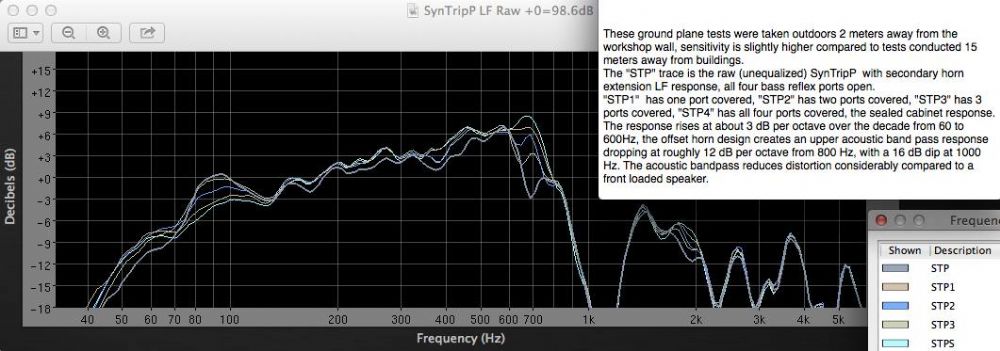 If you eq the response so that it is flat above 200Hz the notch at 700Hz doesn’t look so bad; especially if the measured graph is smoothed.
The anomaly at about 1.6KHz also shows up in this raw response.
When used in isolation, the polarity will have no effect on the frequency response. If the high frequency response was measured with the mids muted, the polarity is irrelevant whether due to wiring or dsp setting. Inverting the signal won’t change a peak in response to a notch. The phase/polarity only becomes relevant when there are multiple sound sources covering the same frequency range. That said, a reflected sound wave also acts as a secondary source, which will combine with the direct wave, either constructively or destructively.
The ports will have some effect, so conversely, eliminating them should too. Just how much, I don’t know. Apart from the coupling between the compression driver and horn, holes in the walls of the horn would seem to be the only other cause. Tracking down problems is a case of eliminating what is not causing the problem. Covering the ports with duct tape is quick and easy, and will either confirm of eliminate the ports as the problem. |
|||
 |
|||
|
FartyMcfly
Registered User
Joined: 20 July 2023 Status: Offline Points: 31 |
Post Options
Thanks(0)
Quote Reply
Posted: 17 June 2025 at 4:25pm |
||
|
At the risk of asking a daft question : did you ask Art Welter for advice on diyaudio?
For what it's worth, I also got some very weird / crappy results when measuring mine, but it was my first time measuring and well, I got a few food pointers that made me think it was better to start the measurement process again rather than try to analyse or correct my wonky results. |
|||
|
|||
|
Post Reply
|
Page <12 |
| Tweet |
| Forum Jump | Forum Permissions You cannot post new topics in this forum You cannot reply to topics in this forum You cannot delete your posts in this forum You cannot edit your posts in this forum You cannot create polls in this forum You cannot vote in polls in this forum |


 Topic Options
 Hmmm but it's nowhere near as severe in Art's measurements, or am I mistaken? In our measurements it's a ~12db dip, in art's it's only ~6db